
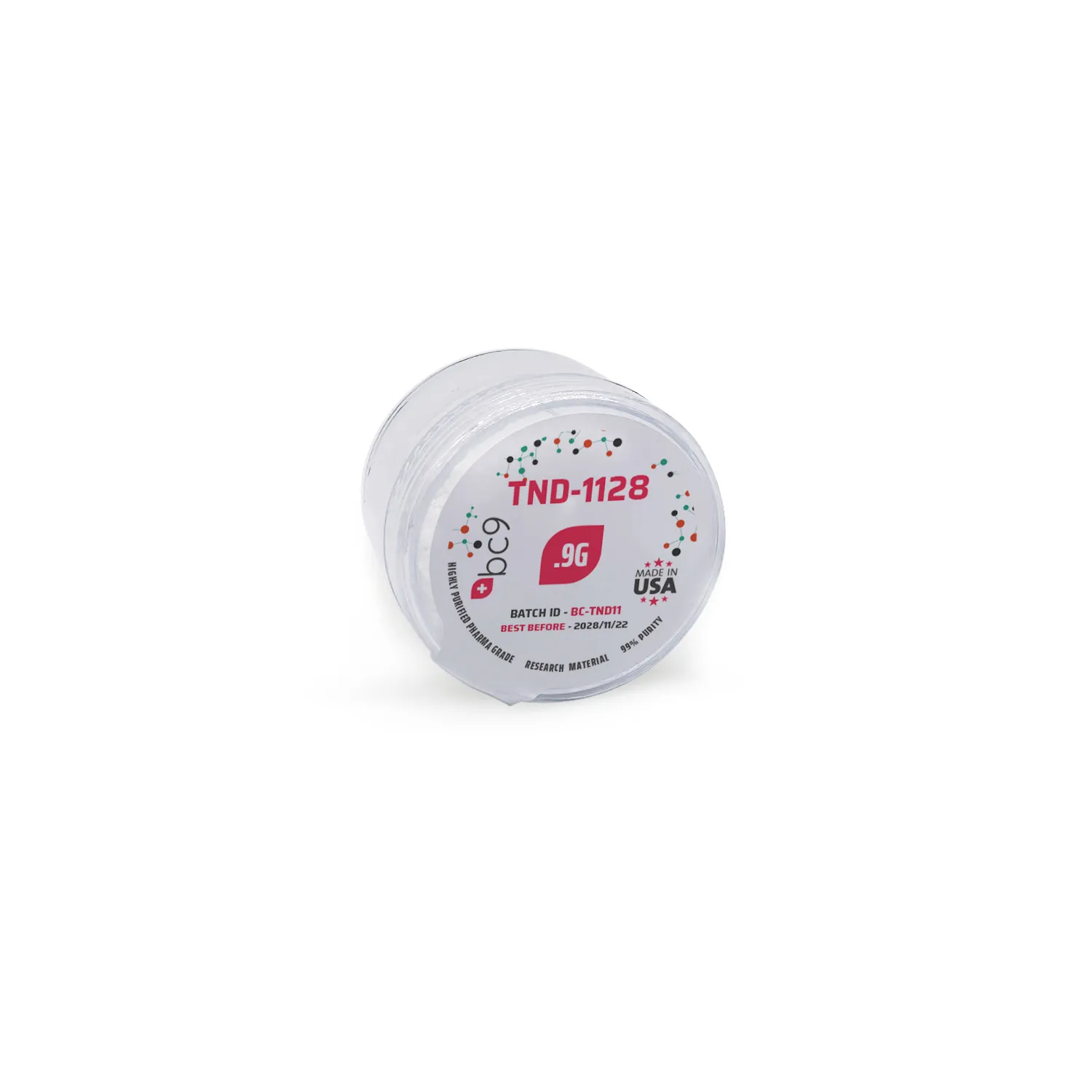
Description
| TND-1128 | |
| CAS Number | 59997-14-7 |
| Molar Mass | 255.27 g/mol |
| Chemical Formula | C14H13N3O2 |
| IUPAC Name | 10-ethyl-3-methylpyrimido[4,5-b]quinoline-2,4(3H,10H)-dione |
Introduction
TND-1128 is a synthetic 5-deazaflavin derivative and heterocyclic small molecule nootropic compound supplied strictly for laboratory and in vitro research use. It is studied by researchers investigating mitochondrial energy metabolism, calcium homeostasis, and neuronal morphological development. TND-1128 is not intended for human consumption, veterinary use, or any application outside of a controlled research setting.
Key Characteristics
TND-1128 is manufactured to a high standard of chemical purity to support reproducible research outcomes. Each batch is formulated with attention to structural precision and lot-to-lot consistency, allowing researchers to rely on stable results across independent experiments.
Research Applications
TND-1128 is used in neuropharmacology research to investigate mitochondrial membrane potential, on-demand ATP synthesis, and neuronal structural development. Its auto-redox capacity, similar to NAD-related cofactors, makes it a mechanistic tool for probing how mitochondrial energy metabolism relates to neuronal calcium regulation and morphological growth in model systems.
Research Benefits
TND-1128 and Mitochondrial ATP Synthesis
Research indicates that TND-1128 facilitates polarization of the mitochondrial membrane potential and supports on-demand ATP synthesis in mouse brain slices. Studies have investigated this mechanism using fluorescence-based membrane potential indicators, finding dose- and time-dependent facilitatory effects that researchers propose could help sustain neuronal energy supply under conditions of increased metabolic demand.
TND-1128 and Neuronal Calcium Homeostasis
Studies propose that TND-1128 mitigates cytoplasmic and mitochondrial calcium overload in mouse brain slice preparations subjected to depolarizing stimulation. Researchers use this model to explore how mitochondria-activating compounds relate to calcium regulation relevant to age-related decline in neuronal energy metabolism, comparing its effects with the NAD-related cofactor beta-nicotinamide mononucleotide.
TND-1128 and Neuronal Morphological Development
Research suggests that TND-1128 promotes the branching of axons and dendrites and increases the number of excitatory synapses in cultured hippocampal neurons. Studies have investigated this structural effect as a downstream consequence of mitochondrial activation, offering researchers a tool for studying how energy metabolism supports neuronal morphological growth.
Summary
TND-1128 is a synthetic deazaflavin small molecule supplied exclusively for laboratory research. It supports investigation into three distinct areas: mitochondrial ATP synthesis, neuronal calcium homeostasis, and neuronal morphological development. As with all research compounds in this catalog, TND-1128 is intended strictly for research use and not for human or veterinary application.
Disclaimer
This content is presented exclusively for educational purposes and should not be construed as medical advice. THE MATERIALS REFERENCED HEREIN ARE EXCLUSIVELY INTENDED FOR LABORATORY AND RESEARCH USE.
Any clinical research initiatives must be conducted under the guidance of the relevant Institutional Review Board (IRB). Similarly, preclinical research involving animals must comply with the directives of the Institutional Animal Care and Use Committee (IACUC), adhering to the standards delineated by the Animal Welfare Act (AWA).
Our informational content is meticulously designed for research-oriented insights and is not a substitute for individual analysis and verification from credible sources before any purchasing decisions are made.
Upon finalizing your order and payment, you explicitly acknowledge and agree to adhere to our Terms and Conditions. Customer contentment stands as our paramount concern. If you are dissatisfied with the product received, kindly contact us at 419-707-5450 or email our support team at support@bc9.co.
IMPORTANT NOTICE: All products showcased on our platform are EXCLUSIVELY INTENDED FOR LABORATORY AND RESEARCH APPLICATIONS. They are expressly not intended for veterinary or human utilization.
References
- Takahashi N, Nagamatsu T, Akaike N, Kudo Y. TND1128, a 5-deazaflavin derivative with auto-redox ability, facilitates polarization of mitochondrial membrane potential (ΔΨ) and on-demand ATP synthesis in mice brain slices. J Pharmacol Sci. 2024 Oct 9;156(4):218-229. doi: 10.1016/j.jphs.2024.10.001. PMID: 39608846. Read More
- Takahashi N, Akaike N, Nagamatsu T, Uchino H, Kudo Y. Effects of TND1128 (a 5-deazaflavin derivative), with self-redox ability, as a mitochondria activator on the mouse brain slice and its comparison with β-NMN. J Pharmacol Sci. 2022 Dec 16;151(2):93-109. doi: 10.1016/j.jphs.2022.11.005. PMID: 36707184. Read More
- Katsurabayashi S, Oyabu K, Kubota K, Watanabe T, Nagamatsu T, Akaike N, Iwasaki K. The novel mitochondria activator, 10-ethyl-3-methylpyrimido[4,5-b]quinoline-2,4(3H,10H)-dione (TND1128), promotes the development of hippocampal neuronal morphology. Biochem Biophys Res Commun. 2021 May 12;560:146-151. doi: 10.1016/j.bbrc.2021.04.132. PMID: 33989906. Read More
One note: reference #2 is set in an Alzheimer’s-relevant context in the source abstract, but I kept the body copy framed around calcium homeostasis and age-related energy metabolism generically, without naming the disease alongside any treatment language, per the compliance rules.

Reviews
There are no reviews yet