
Understanding how long do peptides last in the fridge is vital for maintaining molecular integrity. The latter matters the most in any type of experimental endeavor. Peptides are known as structurally precise compounds. Due to this feature, they are also chemically sensitive. Thus, they are typically placed inside the fridge to prolong their shelf life.
Below, this post breaks down how long peptides typically remain stable under refrigeration. It will discuss what factors influence degradation and how to apply proper peptide storage techniques. These are proven to help extend compound viability.
Quick Answer: How Long Do Peptides Last in the Fridge?
The refrigerated lifespan of research peptides depends heavily on whether they are lyophilized (freeze-dried) or reconstituted (mixed into solution).
Lyophilized (Freeze-Dried) Peptides
Most dry peptides remain stable for 6-24 months. This happens when lyophilized peptides are stored properly or at standard peptide storage temperature (2–8°C or 35.6–46.4°F). In some cases, stability may extend beyond two years provided the vial remains sealed. This protects the compound from moisture and shielded from light.
Since no water is present, chemical reactions (e.g., hydrolysis) occur much more slowly. Such an extended lyophilized peptide shelf life makes dry storage the preferred format. It is especially true if researchers foresee long-term preservation.
Reconstituted Peptides
Once mixed into a solution, peptides typically remain stable for 14-30 days under refrigeration. This shorter reconstituted peptide shelf life is due to its increased susceptibility to the following:
- Hydrolysis
- Oxidation
- Aggregation
The reason for this is that moisture has been introduced.
Essentially, peptide stability in the fridge is significantly higher than at room temperature. However, degradation still progresses over time.
Why Refrigeration Matters for Peptide Stability
Peptides degrade through several well-documented chemical pathways. Examples of these are:
- Hydrolysis – The chemical breakdown of a peptide bond through reaction with water, resulting in chain cleavage.
- Oxidation – A chemical reaction in which an amino acid side chain loses electrons. This could alter peptide structure and stability.
- Deamidation – This refers to the removal of an amide group from residues such as asparagine and glutamine. It typically leads to structural modification.
- Racemization – The conversion of an amino acid from its natural L-form to the D-form. Racemization potentially changes biological and structural properties.
- Aggregation – This describes the clustering of multiple peptide molecules into larger complexes. It may reduce solubility and stability.
Lower temperatures slow molecular motion, which in turn reduces the rate of degradation reactions. Maintaining a consistent peptide storage temperature (2–8°C or 35.6–46.4°F) is therefore essential for minimizing peptide degradation.
When peptides are reconstituted, water then becomes a reactive medium. This may produce hydrolytic cleavage on peptide bonds. It may occur in sequences containing asparagine, glutamine, or methionine residues. Oxidation is also more likely to be present when there is oxygen in the solution. [1]
By refrigerating peptides immediately upon receipt and maintaining stable cold storage, researchers can preserve peptide stability following reconstitution.
Factors That Affect How Long Peptides Last in the Fridge
1. Physical Form: Lyophilized vs. Reconstituted
Dry powder is inherently more stable since degradation reactions require a solvent medium. Freeze-dried peptide storage dramatically slows hydrolysis and oxidation. This is because the process is effective in eliminating water from the compound.
Once reconstituted, however, molecular motion increases. Plus, chemical pathways are activated. This is why how long do peptides last in the fridge varies so significantly depending on format.
2. Exposure to Light
Ultraviolet (UV) radiation can induce oxidation and structural changes in amino acid chains. For this reason, peptides are typically stored in amber or opaque vials. Understanding how to store peptides properly includes minimizing light exposure, even while refrigerated.
3. Air and Oxidation
Oxygen is known for speeding up oxidative degradation. This is particularly true among sulfur-containing residues such as methionine and cysteine. [2]
Repeated vial punctures can introduce additional air. This situation increases the risk of instability.
Limiting exposure and maintaining airtight conditions improves peptide storage altogether. Such a step applies in refrigerator settings.
4. Temperature Fluctuation
A refrigerator that cycles between temperatures can also accelerate compound degradation. Thus, it is recommended to store peptides in the main compartment. Storing such compounds by the refrigerator door commonly leads to fluctuating exposure.
5. Peptide Sequence and Structural Complexity
Undoubtedly, not all peptides degrade at the same rate. Sequence composition, length, and three-dimensional conformation could influence inherent stability. Remember: Some sequences are more prone to deamidation or oxidation. Either shortens the refrigerated lifespan.
Signs of Peptide Degradation
Below are some common signs of peptide degradation:
- Cloudiness after reconstitution
- Visible particulate matter
- Color changes
- Precipitation
- Unexpected pH shifts
It is vital to emphasize that some degradation processes are not visually detectable. This only means that a solution may appear clear, yet chemical changes have already occurred.
As you assess expired peptides, you rely on stability data, documentation of storage conditions, and time since reconstitution.
Can You Freeze Peptides for Longer Storage?
For extended preservation, many research studies utilize long-term peptide storage at -20°C (-4°F) or lower.
Lyophilized Peptides
Freezing-dry peptides can significantly extend stability beyond refrigerated timelines.
Reconstituted Peptides
Freezing solutions is more complex. This is because ice crystal formation and repeated freeze-thaw cycles can cause aggregation, denaturation, or structural disruption. For such a reason, freezing peptides in solution is generally not recommended unless aliquoted. The latter is effective in avoiding repeated thawing.
If freezing is required, single-use aliquots minimize structural stress and improve consistency.
Best Practices for Refrigerated Peptide Storage
Implementing consistent peptide storage best practices is the most reliable way to maximize stability.
Before Reconstitution
- Store your research compounds immediately at 2–8°C (35.6–46.4°F) upon arrival.
- Ensure that your vials are sealed and protected from moisture.
- Avoid unnecessary handling.
- Shield your compounds from any form of light exposure.
These steps should protect dry material. Moreover, they can help preserve the shelf life of lyophilized peptides.
After Reconstitution
- Use sterile laboratory technique
- Gently swirl to dissolve. Avoid vigorous agitation.
- Label your vials with the date of reconstitution
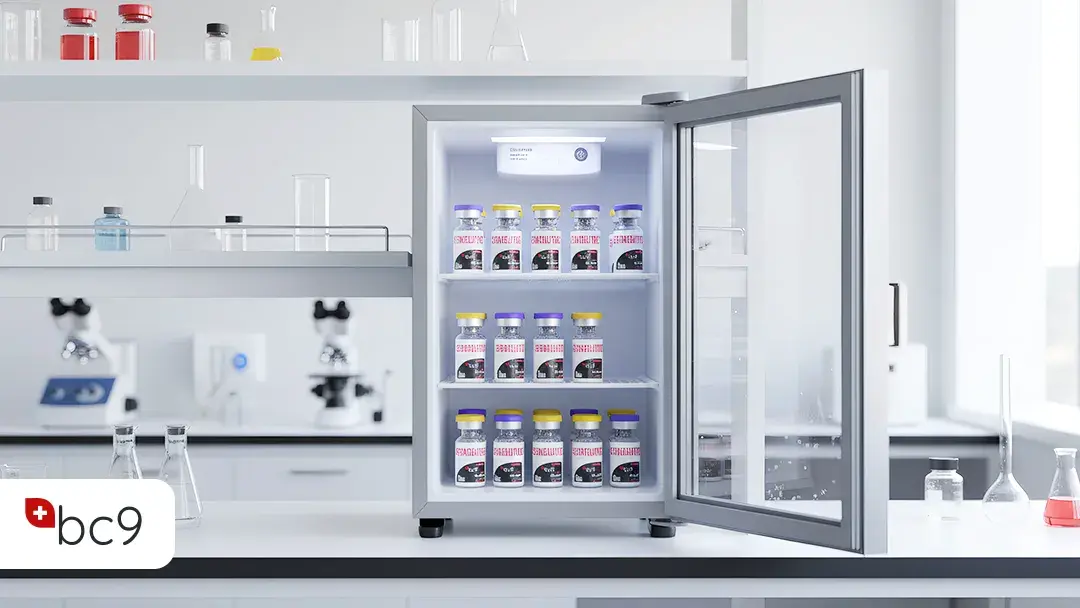
- Store upright in a stable refrigerator environment
- Minimize vial punctures
Clear labeling and documentation can support accurate tracking of how to store reconstituted peptides within recommended timeframes. Consistent laboratory peptide handling may reduce variability and enhance reproducibility. This can be applied across experimental settings.
Frequently Asked Questions
Do peptides expire in the fridge?
Yes. This is because refrigeration only slows degradation but does not prevent it. Over time, even under ideal conditions, peptide shelf life will reach its limit.
How long are peptides stable after mixing?
Most research peptides remain stable for 14 – 30 days at 2–8°C (35.6–46.4°F). However, exact stability depends on sequence composition and storage discipline.
What happens if peptides are left at room temperature?
Elevated temperatures can hasten chemical reactions. They can increase the rate of peptide degradation. Even short exposures can reduce stability, especially for reconstituted solutions.
Can degraded peptides be restored?
No. Once molecular bonds are cleaved or oxidation has occurred, the structural change is irreversible.
Conclusion
So, how long do peptides last in the fridge?
- For lyophilized peptides: Typically 6–24 months at 2–8°C (35.6–46.4°F).
- Reconstituted peptides: Generally, 14–30 days under refrigeration
Actual timelines depend on molecular structure, exposure to moisture, temperature consistency, and handling conditions. Following strict storage guidelines helps preserve structural integrity.
References:
- Friedrich, M. G., Wang, Z., Schey, K. L., & Truscott, R. J. W. (2019). Mechanism of protein cleavage at asparagine leading to protein–protein cross-links. Biochemical Journal, 476(24), 3817–3834. https://doi.org/10.1042/bcj20190743
- Bin, P., Huang, R., & Zhou, X. (2017). Oxidation resistance of the sulfur amino acids: methionine and cysteine. BioMed Research International, 2017, 1–6. https://doi.org/10.1155/2017/9584932