
Description
Disclaimer: This compound is provided strictly for laboratory and scientific research purposes only. It is not approved by the U.S. Food and Drug Administration (FDA) for human or veterinary use, including ingestion, injection, or any form of administration.
Research Transparency Note: No peer-reviewed PubMed publications specific to Adamax as a named compound are available as of June 2026. References below relate to the Semax/ACTH(4-10) parent compound class and the BDNF/TrkB receptor pharmacology directly relevant to Adamax’s proposed mechanism. Adamax-specific preclinical data are limited to vendor characterisation and non-peer-reviewed investigational reports. This is a mandatory disclosure for any Adamax research programme.
Chemical Properties of the Compound
| Property | Details |
| Compound Name | Adamax (N-Acetyl Semax Adamantane) |
| Parent Compound | Semax – Met-Glu-His-Phe-Pro-Gly-Pro | ACTH(4–10) heptapeptide analogue |
| Modifications | N-terminal acetylation (exopeptidase resistance) + C-terminal adamantane moiety (lipophilicity / BBB penetration/half-life extension) |
| Reported Sequence | Ac-Met-Glu-His-Phe-Pro-Gly-Pro-Adamantyl-Gly-NH₂ |
| Approximate MW | ~470–490 Da (salt form dependent; ~72 Da above Semax due to adamantane addition) |
| Compound Class | ACTH-derived nootropic neuropeptide | Semax family derivative | NOT a SARM |
| Primary Receptor Target | MC4R (Melanocortin Receptor 4) – partial agonist (proposed; extrapolated from Semax class pharmacology) |
| Downstream Target | BDNF (Brain-Derived Neurotrophic Factor) upregulation → TrkB receptor sensitisation in hippocampal models |
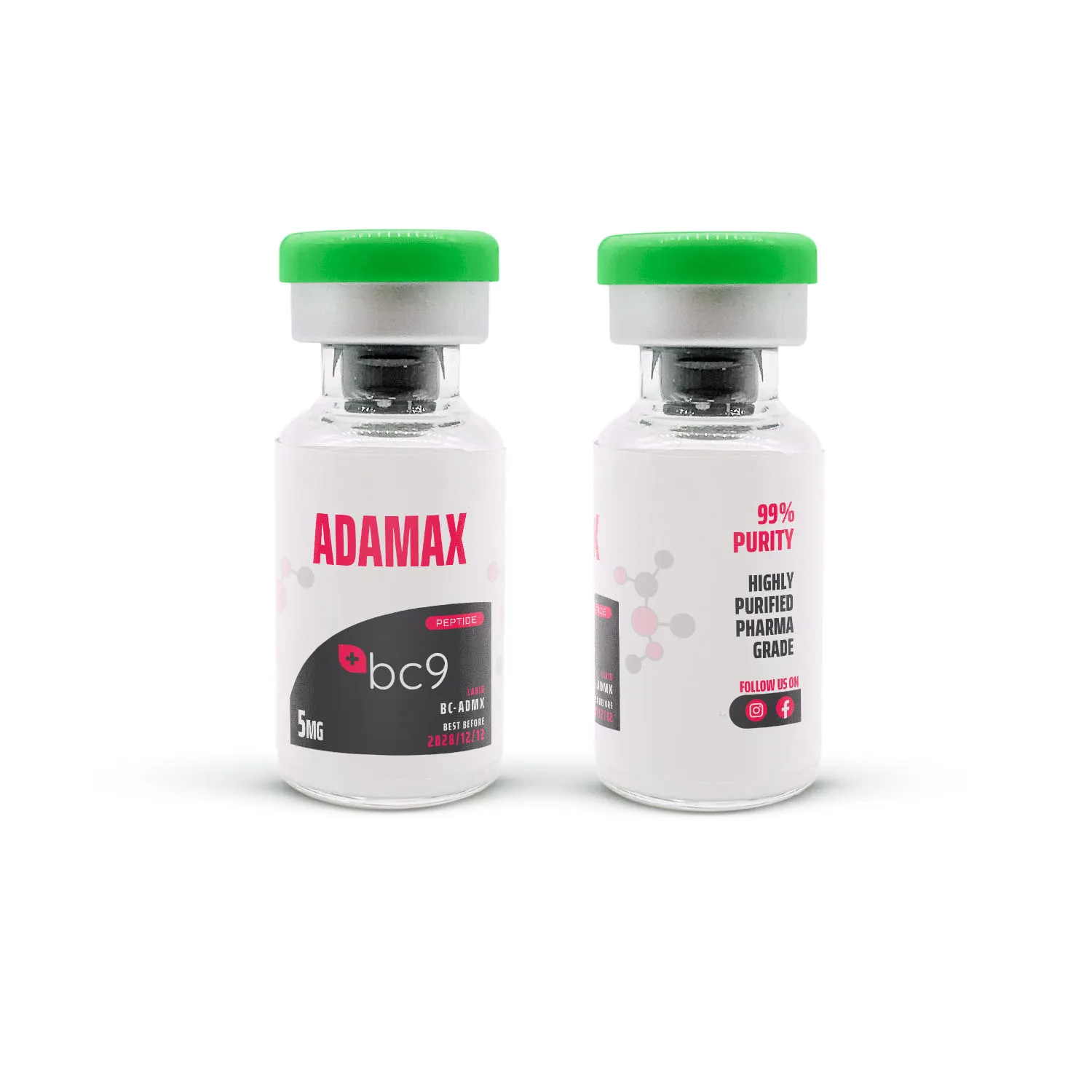
| Physical Form | Lyophilized powder | 5mg per vial |
| Purity | ≥98% |
| Solubility | Soluble in sterile water or 0.1% acetic acid at research concentrations |
| Stability / Shelf Life | ≥24 months lyophilized; ~30 days reconstituted at 2–8°C |
| Storage Instructions | −20°C long term; 2–8°C short term (days to weeks); sealed, light-protected |
| IUPAC Name | Not formally assigned as of June 2026 (compound-specific CAS/IUPAC absent from public databases) |
| Regulatory Status | Not FDA-approved | Research use only | No WADA classification identified | Not a scheduled substance |
| Purity Percentage | ≥98% |
Overview
Adamax is a synthetic nootropic neuropeptide derivative engineered as a structurally enhanced analogue of Semax (Met-Glu-His-Phe-Pro-Gly-Pro) – the well-characterised heptapeptide analogue of adrenocorticotropin fragment ACTH(4–10) developed at the Institute of Molecular Genetics of the Russian Academy of Sciences. Adamax extends the Semax platform with two pharmacokinetic modifications: N-terminal acetylation, which removes the free α-amino terminus vulnerable to aminopeptidase-mediated N-terminal cleavage and thereby extends plasma stability; and a C-terminal adamantane (adamantyl) moiety, a diamondoid hydrocarbon cage scaffold (C₁₀H₁₆) that increases compound lipophilicity above the threshold for efficient passive transcellular membrane diffusion and BBB penetration. The adamantane scaffold is the same lipophilic modification used in the CNS-active drugs amantadine and memantine to achieve brain bioavailability. The combination is designed to deliver the Semax core ACTH-derived BDNF/TrkB-activating sequence to CNS targets with a meaningfully longer half-life and higher CNS concentrations than unmodified Semax, which has a plasma half-life of minutes due to peptidase degradation.
Adamax is not FDA-approved for any indication. It is not a dietary supplement or consumer product. Availability is restricted to qualified researchers and licensed laboratory institutions. No peer-reviewed published data specific to Adamax as a named compound are available as of June 2026 – the mechanistic framework relies on the parent Semax compound data. IRB guidance required for clinical research. IACUC compliance required for preclinical animal research.
Working Mechanism of Adamax
MC4R Partial Agonism → BDNF Upregulation → TrkB Sensitisation: The Semax core sequence (Met-Glu-His-Phe-Pro-Gly-Pro) has been characterized in peer-reviewed preclinical data as an ACTH(4–10)-derived heptapeptide with partial agonist activity at melanocortin receptor 4 (MC4R), initiating a CREB-dependent downstream cascade that drives transcription of BDNF exon III mRNA in hippocampal tissue. Dolotov et al. (2006, Brain Res, PMID 16996037) documented that a single intranasal Semax application (50 µg/kg) produced a 3-fold increase in hippocampal BDNF exon III mRNA, a 1.4-fold increase in BDNF protein levels, and a 1.6-fold increase in TrkB (NTRK2) tyrosine phosphorylation – establishing the BDNF/TrkB axis as the mechanistic substrate for Semax-class cognitive pathway activity in rodent models. Adamax is proposed to engage this same MC4R → BDNF → TrkB axis with improved pharmacokinetic properties attributable to the adamantane modification.
Adamantane C-Terminal Modification → Enhanced Pharmacokinetics: In pharmaceutical chemistry, C-terminal adamantane conjugation to bioactive peptides is a documented strategy for improving lipophilicity, passive membrane permeability, and CNS tissue penetration. The adamantane cage (C₁₀H₁₆, MW 136.23 Da) adds approximately 72 Da to the Semax molecular weight while dramatically increasing logP (lipophilicity). This positions Adamax above the BBB penetration threshold more reliably than water-soluble parent Semax. In ACTH-derived peptide research, the combination of N-terminal acetylation + C-terminal hydrophobic modification is an established pharmacokinetic optimisation strategy for extending half-life and improving target tissue distribution, analogous to the C-terminal amidation strategies used in synthetic melanocortin peptide research tools.
TrkB / MAPK-ERK / PI3K-Akt Downstream Signalling in Hippocampal Models: BDNF elevation downstream of Semax/MC4R activation engages TrkB (tropomyosin receptor kinase B, NTRK2) on hippocampal and cortical neurons. TrkB dimerization upon BDNF binding initiates autophosphorylation at Tyr490, Tyr515, and Tyr816 – recruiting Shc/Grb2/SOS adaptor complexes (activating RAS → RAF → MEK → ERK1/2 MAPK cascade) and PI3K → Akt (anti-apoptotic signalling and mTORC1 pathway activation). A second published data point (Dolotov et al. 2006, J Neurochem, PMID 16635254) confirmed Semax binding specifically to rat basal forebrain cell membranes and concurrent BDNF protein elevation – establishing the spatial localisation of Semax/ACTH-derived peptide activity in the basal forebrain. Adamax is investigated as a research tool for probing this BDNF/TrkB/MAPK-ERK cascade with extended CNS exposure relative to the parent compound.
Research Findings / Research Applications
Preclinical investigations have examined the Semax parent compound class (relevant to Adamax’s proposed mechanism) in relation to:
- BDNF/TrkB signalling pathway research: Semax (50 µg/kg intranasal) produced 3-fold BDNF exon III mRNA upregulation and 1.6-fold TrkB tyrosine phosphorylation in rat hippocampus (Dolotov et al. 2006, PMID 16996037). Adamax is investigated as an extended-half-life version of this BDNF/TrkB activation platform for in vitro hippocampal and cortical neuron model research
- MC4R neuropeptide structure-activity research: As a Semax-class ACTH(4–10) derivative with dual N-terminal and C-terminal modifications, Adamax is investigated in comparative SAR studies examining how acetylation and adamantane modification alter MC4R binding affinity, BDNF upregulation potency, and duration of TrkB pathway activation relative to unmodified Semax in melanocortin receptor-expressing neuronal cell model systems
- Adamantane peptide modification pharmacokinetics: The adamantyl C-terminal conjugation provides a research tool for investigating BBB penetration efficiency, plasma stability, and CNS tissue distribution of adamantane-modified vs unmodified peptides in rodent pharmacokinetic model systems
- ACTH-derived neuropeptide neuroprotection research: The Semax class has been investigated for neuroprotective activity in ischaemic and excitotoxicity rodent models via BDNF/TrkB pathway upregulation. Adamax is investigated as an extended-half-life analogue for probing equivalent neuroprotective pathway activation in cell-based ischaemia and oxidative stress model systems
Note: These findings are based on early-stage and preclinical research. Results are not consistent across all models, and data remain limited without validation in human clinical settings.
Risks & Handling Information
- The use of appropriate personal protective equipment (PPE) is essential in conducting experiments with Adamax. Nitrile gloves, a laboratory coat, and eye protection are required at a minimum.
- Handling should occur within controlled laboratory environments designed for research activities. Reconstitute under aseptic conditions with sterile water or 0.1% acetic acid. Handle as a CNS-active neuropeptide research compound.
- Do not inhale, ingest, or make direct skin contact with the compound. Adamax is a CNS-active ACTH-derived neuropeptide with proposed MC4R agonist activity; unintended exposure may produce CNS pathway activation in biological systems.
- The toxicological profile of Adamax is not established in any published peer-reviewed study. No chronic toxicity data exists for any concentration. No human safety data has been established for research-grade Adamax. Exposure risks remain uncertain due to the complete absence of published toxicological characterization. The absence of documented adverse signals reflects data scarcity, not confirmed safety.
- Improper storage conditions, including exposure to heat, light, or moisture, may result in peptide degradation and compromised research sample integrity. Store lyophilized at −20°C long term; 2–8°C short term. Sealed, light-protected.
FAQs
How does Adamax differ from Semax in terms of research utility?
Semax (Met-Glu-His-Phe-Pro-Gly-Pro) has a plasma half-life of minutes due to N-terminal aminopeptidase cleavage and general peptidase activity. Adamax addresses both liabilities: N-terminal acetylation blocks aminopeptidase N-terminal cleavage, and the C-terminal adamantane moiety increases lipophilicity for improved BBB penetration and extended plasma residence. For in vitro CNS cell model research where compound stability in media and CNS penetration are study variables, Adamax is the appropriate Semax-class research tool for assay designs requiring longer-duration BDNF/TrkB pathway engagement.
Does peer-reviewed literature exist for Adamax specifically?
No. Adamax is a vendor-designated compound name for a specific N-Acetyl Semax + adamantane modification. No peer-reviewed PubMed publications have been identified for Adamax as a named compound as of June 2026. Researchers must rely on parent compound Semax data (Dolotov et al. 2006, PMID 16996037; PMID 16635254) as the mechanistic framework and treat Adamax-specific research as a preliminary investigation pending independent compound-specific data.
What receptor does Adamax target?
Based on Semax parent compound pharmacology, Adamax is proposed to act as a partial MC4R agonist, initiating CREB-dependent BDNF exon III transcription and downstream TrkB sensitisation in hippocampal models. Whether the adamantane modification alters receptor binding affinity or subtype selectivity has not been documented in peer-reviewed literature.
What storage conditions are required?
Store lyophilized at −20°C long term; 2–8°C for short-term use (days to weeks). Sealed, light-protected. Reconstituted solution is stable for approximately 30 days at 2–8°C. Avoid repeated freeze-thaw cycles.
Is Adamax a SARM or a prohormone?
No. Adamax is an ACTH-derived neuropeptide derivative. It does not interact with androgen receptors (not a SARM) and does not convert to an active steroid hormone (not a prohormone). It is classified as a nootropic neuropeptide research tool in the Semax/ACTH(4–10) analogue family.
References
- Dolotov OV, Karpenko EA, Inozemtseva LS, et al. Semax, an analog of ACTH(4-10) with cognitive effects, regulates BDNF and trkB expression in the rat hippocampus. Brain Research. 2006;1117(1):54–60. https://pubmed.ncbi.nlm.nih.gov/16996037/
- Dolotov OV, Karpenko EA, Seredenina TS, et al. Semax, an analogue of adrenocorticotropin (4-10), binds specifically and increases levels of brain-derived neurotrophic factor protein in the rat basal forebrain. Journal of Neurochemistry. 2006;97(Suppl 1):82–86. https://pubmed.ncbi.nlm.nih.gov/16635254/
Note: These are the only peer-reviewed PubMed-indexed references that directly support the BDNF/TrkB mechanism attributed to Adamax – because Adamax inherits that mechanism entirely from the Semax core sequence. No Adamax-specific peer-reviewed paper exists.
This content is presented exclusively for educational purposes and should not be construed as medical advice. THE MATERIALS REFERENCED HEREIN ARE EXCLUSIVELY INTENDED FOR LABORATORY AND RESEARCH USE.
Any clinical research initiatives must be conducted under the guidance of the relevant Institutional Review Board (IRB). Similarly, preclinical research involving animals must comply with the directives of the Institutional Animal Care and Use Committee (IACUC), adhering to the standards delineated by the Animal Welfare Act (AWA).
Our informational content is meticulously designed for research-oriented insights and is not a substitute for individual analysis and verification from credible sources before any purchasing decisions are made.
Upon finalizing your order and payment, you explicitly acknowledge and agree to adhere to our Terms and Conditions. Customer satisfaction stands as our paramount concern. If you are dissatisfied with the product received, kindly contact us at 419-707-5450 or email our support team at support@bc9.co.
IMPORTANT NOTICE: All products showcased on our platform are EXCLUSIVELY INTENDED FOR LABORATORY AND RESEARCH APPLICATIONS. They are expressly not intended for veterinary or human utilization.

Reviews
There are no reviews yet