
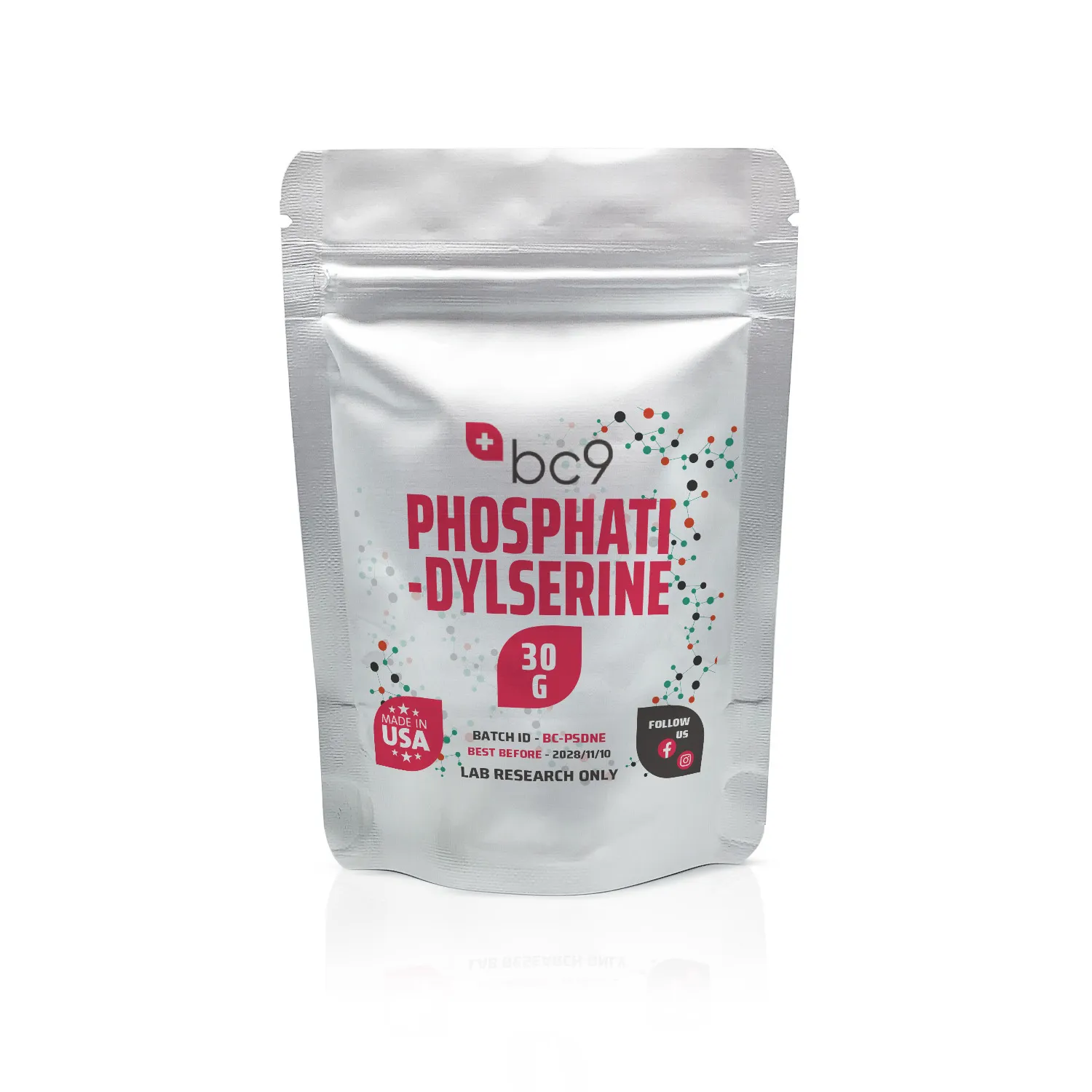
Description
| Phosphatidylserine | |
| CAS Number | CAS 51446-62-9 applies to the 1,2-distearoyl-sn-glycero-3-phospho-L-serine reference species (18:0/18:0). Soy-derived PS preparations contain a mixture of acyl chain compositions – verify the specific species profile against the batch COA. |
| Molar Mass | 792.09 g/mol |
| Chemical Formula | C42H82NO10P |
| IUPAC Name | (2S)-2-amino-3-[[(2R)-2,3-di(octadecanoyloxy)propoxy]-hydroxyphosphoryl]oxypropanoic acid |
Introduction
Phosphatidylserine is a phospholipid supplement derived from soybean lecithin through enzymatic conversion, supplied strictly for laboratory research use. It is studied by researchers investigating cell membrane composition, neuroendocrine signaling, and cognitive function pathways. Phosphatidylserine is not intended for human consumption, veterinary use, or any application outside of a controlled research setting.
Key Characteristics
Phosphatidylserine is manufactured to a high standard of purity and consistent phospholipid composition, supporting reproducible results across independent experiments. Standardized enzymatic conversion from soy lecithin ensures batch-to-batch consistency in phosphatidylserine content.
Research Applications
Phosphatidylserine is used in neuroscience and endocrinology research to investigate cell membrane signaling, hypothalamic-pituitary-adrenal axis regulation, and cognitive performance under physiological stress. It provides researchers with a tool for studying how membrane phospholipid composition relates to neuronal function and stress reactivity in human research models.
Research Benefits
Phosphatidylserine and Memory Function
Research indicates that soybean-derived phosphatidylserine supports neuronal membrane composition in ways that may influence delayed verbal recall, a memory function that declines early in cognitive aging. Studies have investigated this relationship in a randomized, placebo-controlled trial, where research participants with memory complaints and low baseline scores showed improved memory performance following six months of supplementation compared to a placebo.
Phosphatidylserine and HPA-Axis Stress Reactivity
Studies propose that phosphatidylserine, in combination with phosphatidic acid, helps normalize hypothalamus-pituitary-adrenal axis reactivity by moderating the release of ACTH and cortisol in response to an acute psychosocial stressor. Researchers use this model to explore how phospholipid supplementation relates to endocrine stress regulation in chronically stressed research participants.
Phosphatidylserine and Cognitive Performance Under Exercise Stress
Research suggests that soy-derived phosphatidylserine supports faster and more accurate performance on cognitive calculation tasks measured before and after acute resistance exercise. Studies have investigated this mechanism in a randomized, placebo-controlled crossover trial, where supplementation was associated with improved serial subtraction task speed and accuracy prior to exercise in resistance-trained research participants.
Summary
Phosphatidylserine is a soy-derived phospholipid complex supplied exclusively for laboratory research. It supports investigation into three distinct areas: memory function, HPA-axis stress reactivity, and cognitive performance around physical exertion. As with all research compounds in this catalog, phosphatidylserine is intended strictly for research use and not for human or veterinary application.
Disclaimer
This content is presented exclusively for educational purposes and should not be construed as medical advice. THE MATERIALS REFERENCED HEREIN ARE EXCLUSIVELY INTENDED FOR LABORATORY AND RESEARCH USE.
Any clinical research initiatives must be conducted under the guidance of the relevant Institutional Review Board (IRB). Similarly, preclinical research involving animals must comply with the directives of the Institutional Animal Care and Use Committee (IACUC), adhering to the standards delineated by the Animal Welfare Act (AWA).
Our informational content is meticulously designed for research-oriented insights and is not a substitute for individual analysis and verification from credible sources before any purchasing decisions are made.
Upon finalizing your order and payment, you explicitly acknowledge and agree to adhere to our Terms and Conditions. Customer contentment stands as our paramount concern. If you are dissatisfied with the product received, kindly contact us at 419-707-5450 or email our support team at support@bc9.co.
IMPORTANT NOTICE: All products showcased on our platform are EXCLUSIVELY INTENDED FOR LABORATORY AND RESEARCH APPLICATIONS. They are expressly not intended for veterinary or human utilization.
References
- Kato-Kataoka A, Sakai M, Ebina R, Nonaka C, Asano T, Miyamori T. Soybean-derived phosphatidylserine improves memory function of the elderly Japanese subjects with memory complaints. J Clin Biochem Nutr. 2010 Sep 29;47(3):246-55. doi: 10.3164/jcbn.10-62. PMID: 21103034. Read More
- Hellhammer J, Vogt D, Franz N, Freitas U, Rutenberg D. A soy-based phosphatidylserine/phosphatidic acid complex (PAS) normalizes the stress reactivity of hypothalamus-pituitary-adrenal-axis in chronically stressed male subjects: a randomized, placebo-controlled study. Lipids Health Dis. 2014 Jul 31;13:121. doi: 10.1186/1476-511X-13-121. PMID: 25081826. Read More
- Parker AG, Gordon J, Thornton A, et al. The effects of IQPLUS Focus on cognitive function, mood and endocrine response before and following acute exercise. J Int Soc Sports Nutr. 2011 Oct 21;8:16. doi: 10.1186/1550-2783-8-16. PMID: 22017963. Read More

Reviews
There are no reviews yet