
Description
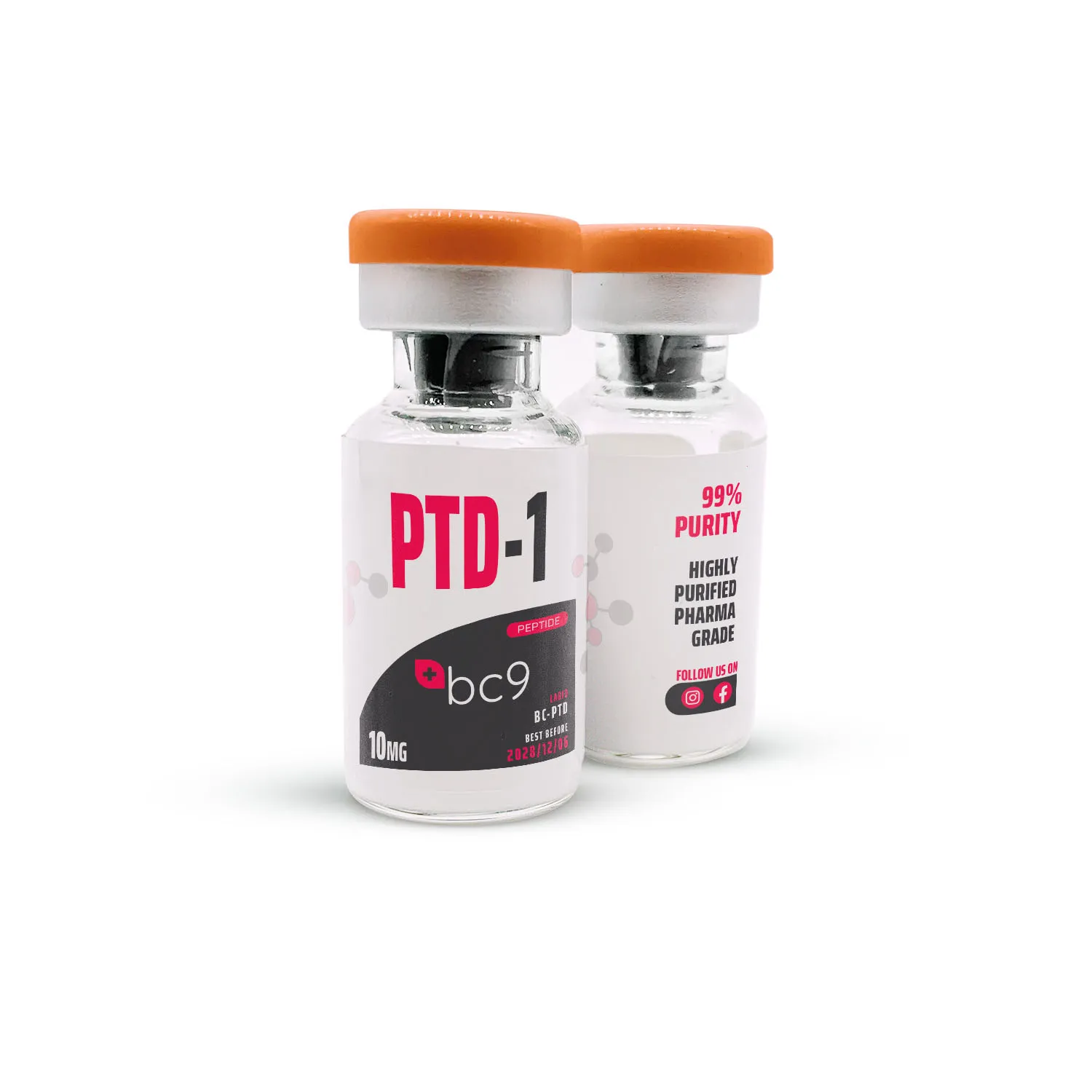
PTD-1 (PTD-DBM) 10mg
PTD-1, also designated PTD-DBM (Protein Transduction Domain–Dishevelled Binding Motif), is a synthetic fusion peptide. Researchers study this peptide to interrogate the CXXC5-Dishevelled (Dvl) protein-protein interaction within the canonical Wnt/β-catenin signaling pathway.
It is structurally composed of two functionally distinct domains: a protein transduction domain (PTD) sequence (YARAAARQARA) enabling intracellular delivery, connected via a flexible GG linker to a Dishevelled Binding Motif (DBM) sequence (DPYDSFLYMK) derived from the CXXC5 binding interface. Preclinical data published in the Journal of Experimental Medicine (2015) and Cell Death and Differentiation (2015) established the mechanistic framework underpinning PTD-1’s design and formed the foundation for subsequent investigations into cutaneous wound repair and follicular biology using this compound.
BC9’s PTD-1 is supplied as a lyophilized powder in a 10mg research vial, manufactured to rigorous purity standards and intended strictly for qualified researchers operating within controlled laboratory environments.
| Property | Value |
|---|---|
| CAS Number | 1609454-11-6 | Note: CAS 120287-85-6 refers to the PTD carrier | domain sequence YARAAARQARA only – not the full | PTD-DBM fusion peptide. CAS 1609454-11-6 is | specific to the complete PTD-1 fusion compound. |
| Molecular Weight | ~3082.62 g/mol |
| Molecular Formula | C₁₂₄H₂₂₅N₆₁O₂₈S₂ |
| Sequence | YARAAARQARA-GG-DPYDSFLYMK |
| Synonyms | PTD-DBM, PTD-1, CXXC5-Dvl Inhibitor Peptide |
| Pubchem CID | 176453931 |
| Vial Size | 10mg |
Key Characteristics
PTD-1’s mechanistic interest is centered on its role as a competitive inhibitor of the CXXC5–Dvl protein-protein interaction. CXXC5 functions as a negative-feedback regulator of canonical Wnt signaling by binding to Dvl and suppressing downstream β-catenin activation.
By introducing the DBM sequence into the intracellular environment via its PTD carrier domain, PTD-1 competitively displaces CXXC5 from Dvl, thereby releasing the suppressive brake on Wnt/β-catenin signaling. Preclinical in vitro studies have documented PTD-1’s capacity to induce nuclear translocation of β-catenin, upregulate collagen I and α-smooth muscle actin (α-SMA) expression in dermal fibroblast cultures, and enhance endothelin-1 mRNA levels in a concentration-dependent manner.
Potential Research Applications
Wnt/β-Catenin Signaling Research
Preclinical investigations have identified PTD-1 as a laboratory research compound for studying CXXC5-mediated regulation of canonical Wnt/β-catenin signaling pathways. In vitro experimental data report concentration-dependent modulation of β-catenin localization and downstream transcriptional activity following disruption of the CXXC5–Dishevelled (Dvl) interaction.
Cutaneous Regeneration & Dermal Fibroblast Research
Experimental in vitro studies indicate PTD-1 may influence collagen I expression, fibroblast-associated differentiation markers, and β-catenin-responsive gene signaling within cultured dermal fibroblast systems. Additional preclinical investigations have evaluated PTD-1-associated effects on wound-closure-related parameters in controlled laboratory models.
Hair Follicle & Dermal Papilla Cell Research
Investigational laboratory data suggest PTD-1 may modulate Wnt-associated signaling pathways in dermal papilla cell culture systems. Preclinical studies have examined its relationship to follicular progenitor cell proliferation, anagen-associated signaling activity, and follicle neogenesis-related endpoints under controlled experimental conditions.
Protein–Protein Interaction (PPI) Research
PTD-1 is utilized as an experimental peptide model for investigating the disruption of the CXXC5–Dvl protein-protein interaction. The compound serves as a molecular research tool for examining regulatory feedback mechanisms within canonical Wnt signaling pathways and associated intracellular signaling dynamics.
Extracellular Matrix Research
Preclinical in vitro findings report PTD-1-associated modulation of collagen deposition markers and keratin-14 expression within laboratory culture systems. Ongoing investigations are examining its relevance to epithelial–mesenchymal signaling processes and extracellular matrix remodeling mechanisms in experimental models.
Disclaimer
This content is presented exclusively for educational purposes and should not be construed as medical advice. THE MATERIALS REFERENCED HEREIN ARE EXCLUSIVELY INTENDED FOR LABORATORY AND RESEARCH USE.
Any clinical research initiatives must be conducted under the guidance of the relevant Institutional Review Board (IRB). Similarly, preclinical research involving laboratory subjects must comply with the directives of the Institutional Animal Care and Use Committee (IACUC), adhering to the standards delineated by the Animal Welfare Act (AWA).
Our informational content is meticulously designed for research-oriented insights and is not a substitute for individual analysis and verification from credible sources before any purchasing decisions are made.
Upon finalizing your order and payment, you explicitly acknowledge and agree to adhere to our Terms and Conditions. Customer contentment stands as our paramount concern. If you are dissatisfied with the product received, kindly contact us at 419-707-5450 or email our support team at support@bc9.co.
IMPORTANT NOTICE: All products showcased on our platform are EXCLUSIVELY INTENDED FOR LABORATORY AND RESEARCH APPLICATIONS. They are expressly not for use in veterinary or human utilization.
References
(Lee et al., J Exp Med, 2015) — The foundational paper that first described PTD-DBM by name, established the CXXC5-Dvl interaction as the target, and validated the peptide’s in vitro activity on collagen production and wound repair.
(Lee et al., J Invest Dermatol, 2017) — The primary PTD-DBM hair regrowth study, directly testing the peptide in hair follicle neogenesis models and demonstrating the VPA co-treatment synergy. This is the core efficacy paper for PTD-1.
(Ryu et al., Br J Pharmacol, 2021) — Validates the same CXXC5-Dvl target axis using KY19382, a small-molecule mimetic of PTD-DBM, corroborating the mechanism from a second chemical angle.
(Ryu et al., Cells, 2023) — Places PTD-DBM directly within the DHT→PGD2→CXXC5 androgenetic alopecia cascade, the most recent and mechanistically complete study referencing PTD-DBM by name.

Reviews
There are no reviews yet