
Description
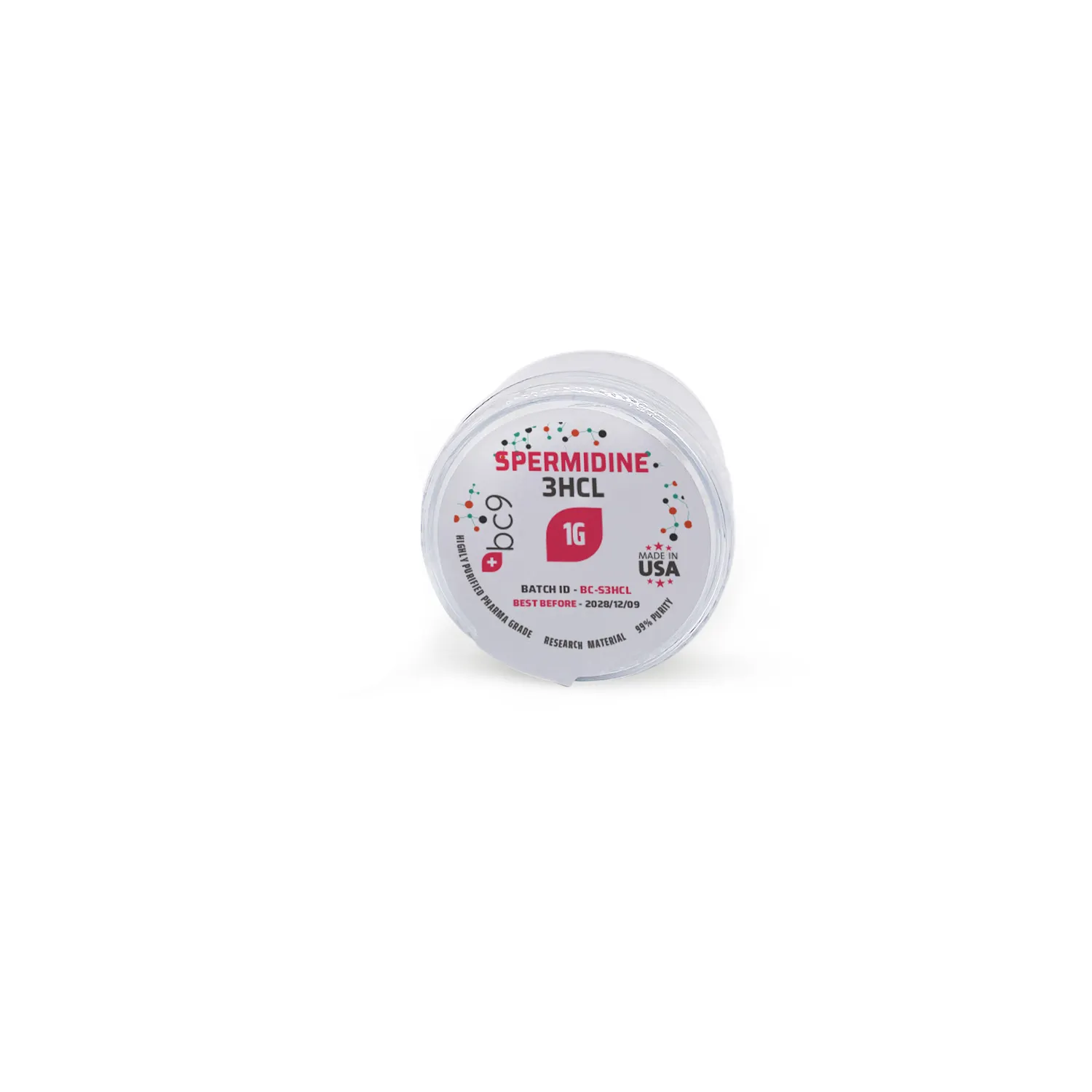
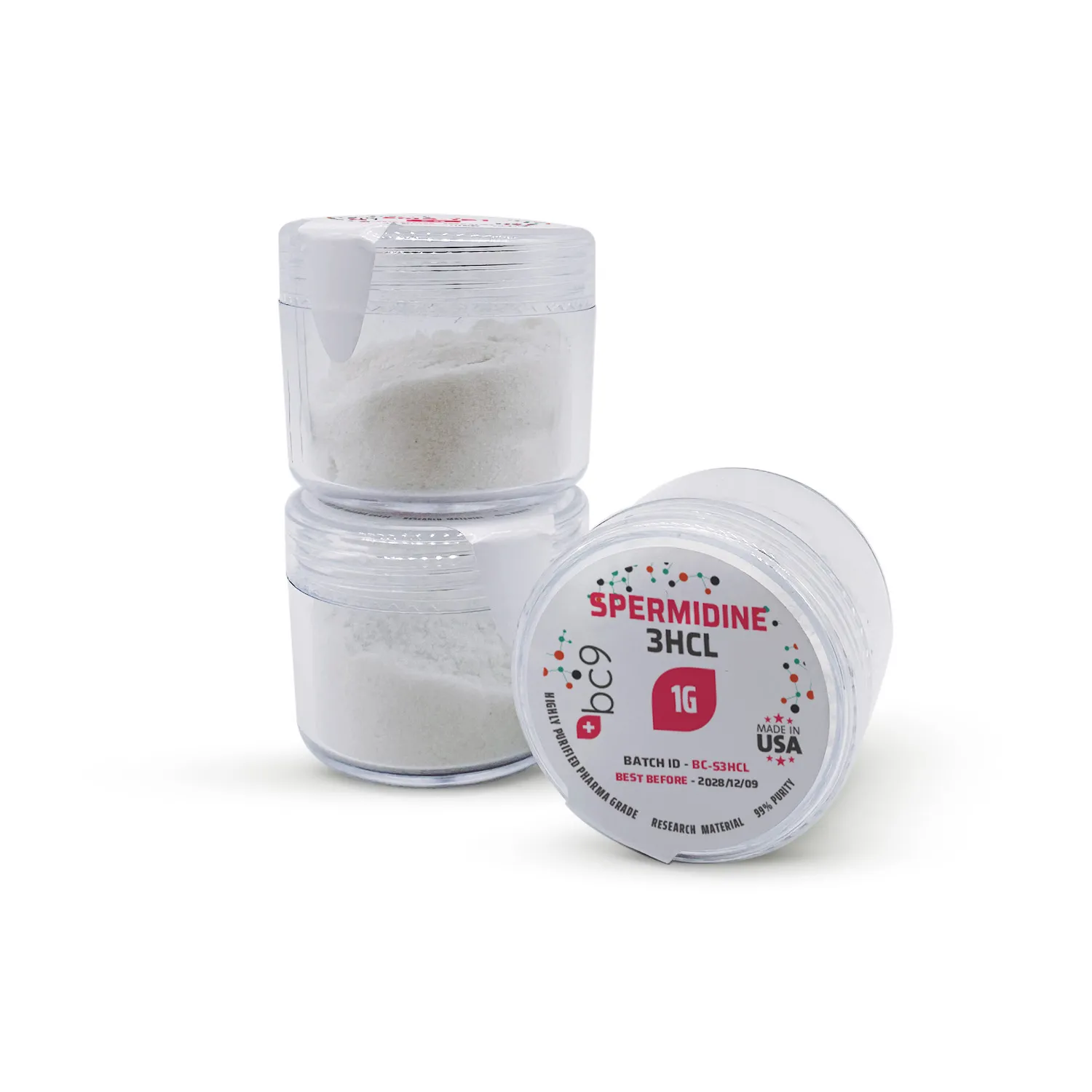
| Spermidine 3HCl | |
| CAS Number | 334-50-9 |
| Molar Mass | 254.63 g/mol |
| Chemical Formula | C7H19N3·3HCl (equivalent: C7H22Cl3N3) |
| IUPAC Name | N-(3-aminopropyl)butane-1,4-diamine trihydrochloride |
Introduction
Spermidine 3HCl is the trihydrochloride salt form of spermidine, a naturally occurring polyamine studied as a research-use-only supplement compound. It is supplied for laboratory investigation into cellular aging, autophagy regulation, and metabolic signaling, and is not intended for human consumption or veterinary use.
Key Characteristics
Spermidine 3HCl is produced to a high standard of chemical purity, with tight lot-to-lot consistency to support reproducible results across independent experiments. Its stable salt form improves handling and solubility relative to free-base spermidine in aqueous research applications.
Research Applications
Spermidine 3HCl is used in cell biology, cardiovascular, and neuroscience research to investigate autophagy pathways, mitochondrial function, and the polyamine metabolism that declines with cellular aging. It provides researchers with a mechanistic tool for probing how endogenous polyamine levels influence cell survival and organ-level function in model systems.
Research Benefits
Spermidine and Cellular Autophagy
Research indicates that spermidine inhibits histone acetyltransferase activity, leading to deacetylation of histone H3 and the upregulation of autophagy-related gene transcripts. Studies have investigated this epigenetic mechanism as the basis for spermidine’s ability to extend lifespan and suppress oxidative stress and necrosis across yeast, fly, worm, and human cell models.
Spermidine and Cardiac Function
Studies propose that spermidine feeding enhances cardiac autophagy and mitophagy, which supports mitochondrial respiration and titin phosphorylation in cardiomyocytes. Researchers use this model to explore how these mechanisms may relate to reduced cardiac hypertrophy and preserved diastolic function in aging animal models.
Spermidine and Cognitive Function
Research suggests dietary spermidine crosses the blood brain barrier and increases hippocampal eIF5A hypusination, a modification linked to mitochondrial respiratory competence in neurons. Studies have investigated this pathway in relation to spatial learning performance and hippocampal function in aged animal models, offering a tool for cognitive aging research.
Summary
Spermidine 3HCl is a polyamine salt supplied exclusively for laboratory research into cellular aging and metabolic signaling. It supports investigation into three distinct areas: autophagy regulation, cardiac mitochondrial function, and cognitive aging. As with all research compounds in this catalog, Spermidine 3HCl is intended strictly for research use and not for human or veterinary application.
Disclaimer
This content is presented exclusively for educational purposes and should not be construed as medical advice. THE MATERIALS REFERENCED HEREIN ARE EXCLUSIVELY INTENDED FOR LABORATORY AND RESEARCH USE.
Any clinical research initiatives must be conducted under the guidance of the relevant Institutional Review Board (IRB). Similarly, preclinical research involving animals must comply with the directives of the Institutional Animal Care and Use Committee (IACUC), adhering to the standards delineated by the Animal Welfare Act (AWA).
Our informational content is meticulously designed for research-oriented insights and is not a substitute for individual analysis and verification from credible sources before any purchasing decisions are made.
Upon finalizing your order and payment, you explicitly acknowledge and agree to adhere to our Terms and Conditions. Customer contentment stands as our paramount concern. If you are dissatisfied with the product received, kindly contact us at 419-707-5450 or email our support team at support@bc9.co.
IMPORTANT NOTICE: All products showcased on our platform are EXCLUSIVELY INTENDED FOR LABORATORY AND RESEARCH APPLICATIONS. They are expressly not intended for veterinary or human utilization.
References
- Eisenberg T, Knauer H, Schauer A, et al. Induction of autophagy by spermidine promotes longevity. Nat Cell Biol. 2009 Oct 4;11(11):1305-14. doi: 10.1038/ncb1975. PMID: 19801973. Read More
- Eisenberg T, Abdellatif M, Schroeder S, et al. Cardioprotection and lifespan extension by the natural polyamine spermidine. Nat Med. 2016 Nov 14;22(12):1428-1438. doi: 10.1038/nm.4222. PMID: 27841876. Read More
- Schroeder S, Hofer SJ, Zimmermann A, et al. Dietary spermidine improves cognitive function. Cell Rep. 2021 Apr 13;35(2):108985. doi: 10.1016/j.celrep.2021.108985. PMID: 33852843. Read More
Reviews
There are no reviews yet