
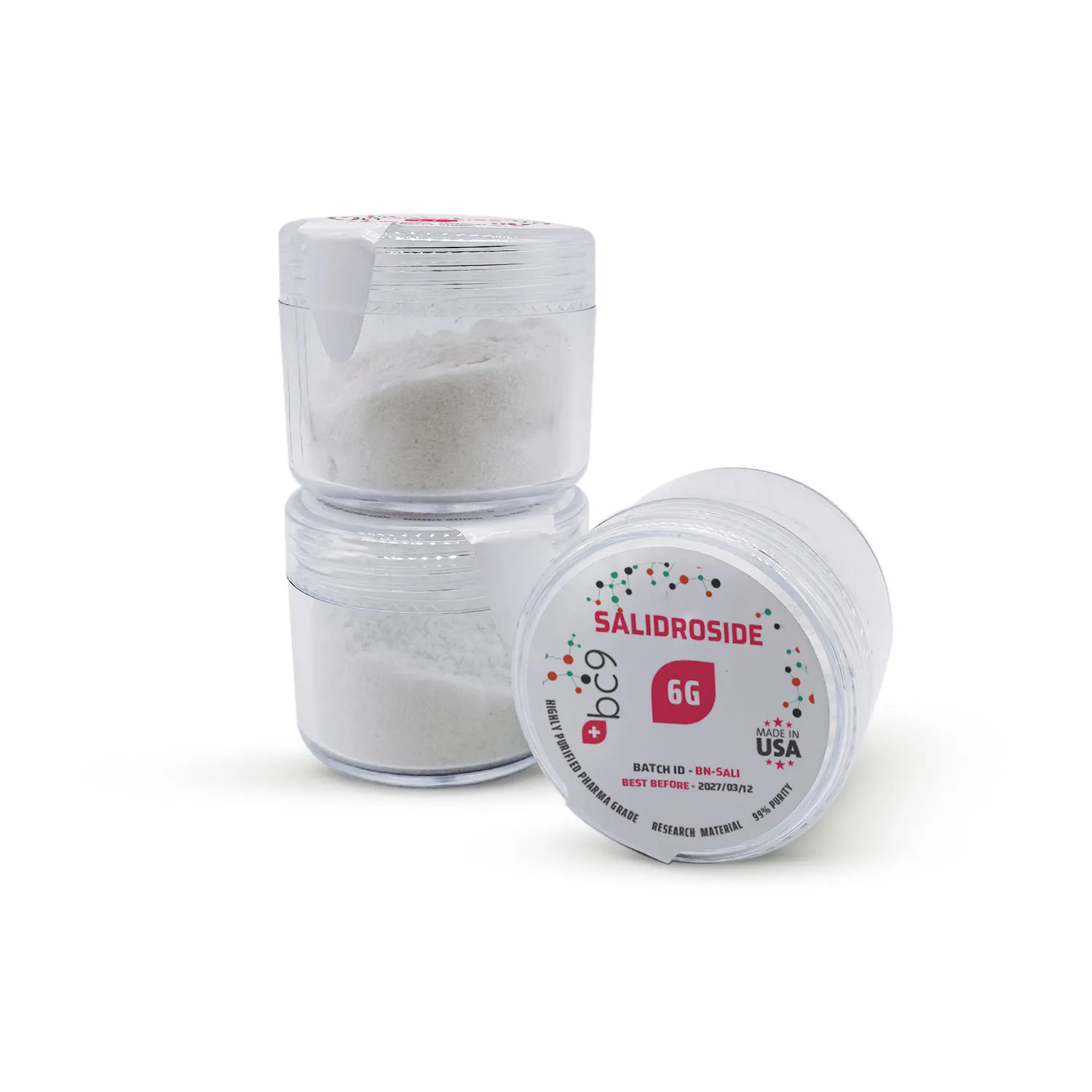
Description
Product Information
| CAS Number | 10338-51-9 |
| Molar Mass | 300.3 g/mol |
| Chemical Formula | C14H20O7 |
| Synonyms | 10338-51-9, Rhodioloside, Rhodosin |
| Shelf Life | Up to 36 months when stored under recommended conditions |
Product Overview
Salidroside powder is a high-purity phenylpropanoid glycoside extracted from Rhodiola rosea. This research product is widely studied for its biochemical activity. As such, salidroside powder has become an important reference compound in various fields. These may include cellular-stress biology, mitochondrial research, and adaptogen-related mechanistic studies. [1]
The investigational product has a well-characterized molecular structure and stability. This explains why salidroside powder is suitable for controlled laboratory experimentation. Also, such a feature enables the product to be useful in exploratory research across multiple disciplines.
Why Choose BC9 to Buy Salidroside Powder Online?
At BC9, our dedication to advancing scientific exploration is reflected by our extensive range of research products. From peptides to nootropics, we offer a comprehensive selection. Each category is tailored to meet the needs of researchers across diverse fields.
We also prioritize consistent quality, transparent sourcing, and rigorous analytical verification. Each batch of our salidroside powder undergoes identity confirmation and purity testing. To achieve this, our product undergoes identity confirmation and purity testing via validated laboratory methods.
Researchers rely on BC9 for materials that support reproducibility and scientific integrity.
Mechanism of Action
Salidroside is recognized for its ability to modulate several cellular pathways. These are typically associated with stress response and energy regulation.
Key mechanistic observations from research include:
- AMPK Pathway Interaction:
Salidroside has been shown to influence AMP-activated kinase. This is a major regulator of cellular energy homeostasis. Modulation of AMPK activity may contribute to shifts in metabolic signaling.[2]
- Mitochondrial Support Mechanisms:
Studies report that salidroside may affect mitochondrial function. This includes ATP production and oxidative phosphorylation efficiency. With this action, salidroside powder is a useful tool for energy-related research models.[3]
- Antioxidant-Related Activity:
Salidroside is believed to influence reactive oxygen species (ROS) and antioxidant enzyme expression. Through such a mechanism, the product is valuable for oxidative stress assays. [4]
- Stress Response Modulation:
Experimental models indicate that salidroside may interact with pathways related to cellular resilience. In turn, the compound aids researchers in understanding cell adaptation. [5]
Potential Research Applications
BC9’s salidroside powder is a flexible research chemical. Thus, it has been utilized in a variety of laboratory and preclinical research contexts. Examples are:
Cellular Stress Biology
Researchers can use salidroside powder to study how cells behave. This especially applies to how they activate defense pathways when exposed to stress. The experiment allows examination of changes in ROS levels and stress-related markers.
Metabolic Regulation Studies
Salidroside is often utilized to analyze metabolic signaling. The goal is to observe AMPK-related pathways. Studies may focus on ATP production, membrane potential, or oxygen consumption.
Neurobiological Research
This potential research application may be applied to neuronal and glial models. Essentially, salidroside helps researchers explore neuroprotective signaling pathways. It allows investigation of markers such as BDNF and proteins. These are recognized to be essential for cellular survival.
Inflammation and Immune-Response Experiments
Salidroside can also support studies focused on inflammatory signaling and immune modulation. Here, researchers can track cytokine production in response to stimuli. This may include IL-6, TNF-α, and IL-1β.
Anti-oxidant Capacity Assays
Some researches that make use of salidroside include antioxidant studies. Part of the objective is to evaluate free-radical scavenging and redox balance. Scientists can also observe how this compound affects resistance to induced oxidative damage.
Frequently Asked Questions
What solvents are compatible with salidroside powder?
Salidroside powder is generally soluble in water, ethanol, and other polar solvents. These should be commonly used in laboratory preparations.
Is salidroside powder safe for human consumption?
No. Salidroside powder is not approved for human consumption. This product is intended exclusively for scientific research.
How should salidroside powder be stored?
It is recommended to store the material in a cool, dry environment. It should be protected from light and moisture to maintain chemical stability.
Does BC9 provide documentation for research compliance?
Yes. When you buy research compounds from BC9, they come with certificates of analysis (COAs).
References
- Liang, K., Ma, S., Luo, K., Wang, R., Xiao, C., Zhang, X., Gao, Y., & Li, M. (2024). Salidroside: An overview of its promising potential and diverse applications. Pharmaceuticals, 17(12), 1703. https://doi.org/10.3390/ph17121703
- Ju, L., Wen, X., Wang, C., Wei, Y., Peng, Y., Ding, Y., Feng, L., & Shu, L. (2017). Salidroside, a natural antioxidant, improves Β-Cell survival and function via activating AMPK pathway. Frontiers in Pharmacology, 8, 749. https://doi.org/10.3389/fphar.2017.00749
- Xing, S., Yang, X., Li, W., Bian, F., Wu, D., Chi, J., Xu, G., Zhang, Y., & Jin, S. (2014). Salidroside Stimulates Mitochondrial Biogenesis and Protects against H2O2-Induced Endothelial Dysfunction. Oxidative Medicine and Cellular Longevity, 2014, 1–13. https://doi.org/10.1155/2014/904834
- Guan, S., Wang, W., Lu, J., Qian, W., Huang, G., Deng, X., & Wang, X. (2011). Salidroside attenuates hydrogen Peroxide-Induced cell damage through a CAMP-Dependent pathway. Molecules, 16(4), 3371–3379. https://doi.org/10.3390/molecules16043371
- Zhu, Y., Zhang, Y., Liu, W., Shi, A., & Gu, N. (2016). Salidroside Suppresses HUVECs Cell Injury Induced by Oxidative Stress through Activating the Nrf2 Signaling Pathway. Molecules, 21(8), 1033. https://doi.org/10.3390/molecules21081033

Reviews
There are no reviews yet