
Description
Product Information
| CAS Number | 14783-68-7 |
| Molar Mass | 172.42 g/mol |
| Chemical Formula | C4H8MgN2O4 |
| Synonyms | 14783-68-7, Bis(glycinato-N,O)magnesium, Magnesium diglycinate, IFN18A4Y6B |
| Shelf Life | 24 months when stored within recommended parameters |
Product Overview
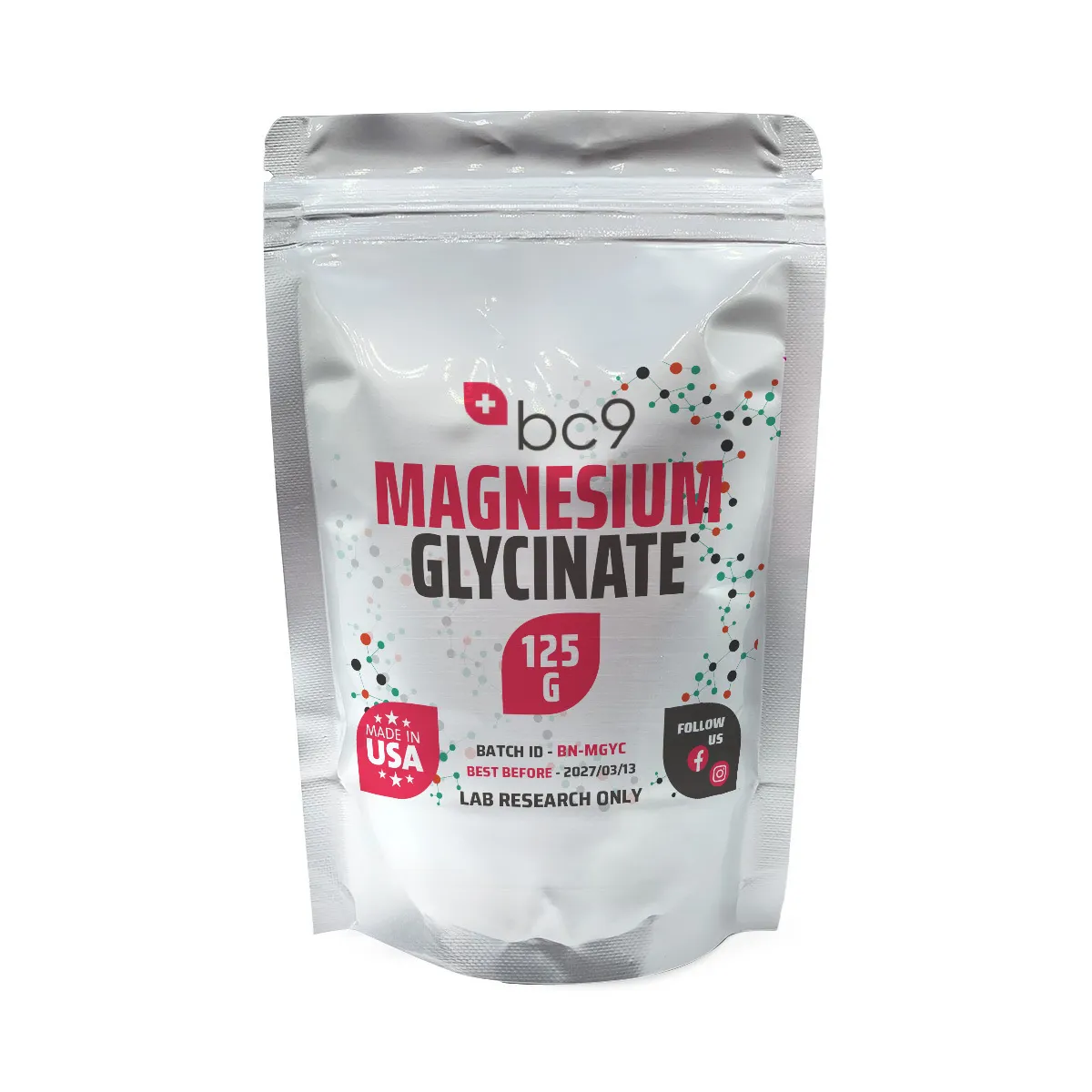
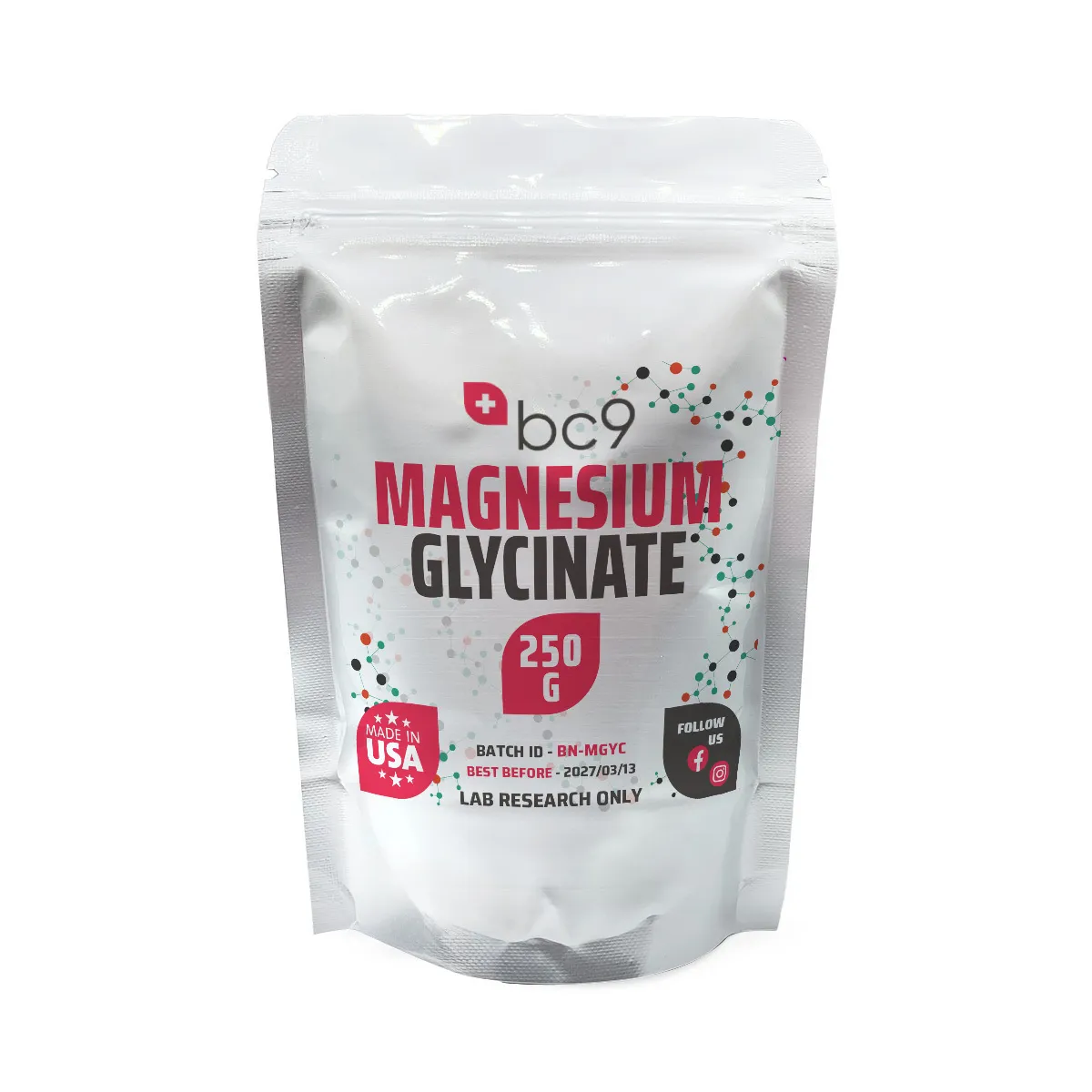
Magnesium glycinate is a chelated compound consisting of magnesium bound to two glycine molecules. This structure enhances stability and solubility. Thanks to this constitution, magnesium glycinate is a popular material for laboratory, formulation, and research environments. [1]
BC9’s magnesium glycinate is produced with high purity and consistent particle characteristics. Thus, it supports controlled experimental work, chemical studies, and formulation development.
Why Choose BC9 to Buy Magnesium Glycinate Powder Online?
Consistent Purity and Quality Control
BC9 sources magnesium glycinate through tightly regulated manufacturing pathways. Each batch undergoes analytical verification, leading to uniform research-grade quality. What is being verified is the following:
- Identity
- Heavy metal screening
- Moisture analysis
- Purity
High Solubility and Ease of Handling
This powder disperses readily within compatible aqueous systems. Thus, researchers can produce accurate measurements and repeatable experimental setups.
Reliable Batch Documentation
BC9 provides certificates of analysis (COAs) to support laboratory documentation.
Secure, Professional Packaging
BC9 delivers its product via sealed, contaminant-resistant packaging. This practice helps preserve product integrity during storage and transport. Moreover, our products come in discreet packaging, which is a plus point for our clients.
Mechanism of Action
Magnesium glycinate is a coordination complex. The compound chelates magnesium ions (Mg2) via glycine glands. This is achieved through nitrogen and oxygen donor sites. Chelation is known for enhancing the stability of the magnesium ion in solution. It may also reduce its reactivity compared with unchelated forms.
In experimental systems, the structure can influence:
- Solubility and Dissolution Behavior: The chelated form may lead to improved dissolution characteristics. This applies in water and buffered solutions. [2]
- Magnesium Ion Availability: A chelated compound results in controlled breakdown. It is typical under certain pH or enzymatic conditions. This action allows researchers to study magnesium release kinetics. [3]
- Interaction with Biological or Synthetic Matrices: Researchers could investigate how chelated magnesium interacts with proteins, transporters, polymers, or other compounds. [4]
Thus, magnesium glycinate demonstrates predictable coordination chemistry. This feature makes it useful in controlled studies where magnesium ion behavior needs precise monitoring.
Potential Research Applications
Magnesium glycinate is frequently selected in research settings. This is primarily due to its chelated structure and predictable behavior. Potential areas of investigation include:
Relaxation and Neurochemical Pathways
Researchers may examine how magnesium-glycine complexes may influence signaling pathways. These are related to relaxation responses, including their interactions with molecules involved in circadian mechanisms.
Muscle Function and Spasm Model
Laboratory studies may use the compound to explore its effects on the following:
- Muscle fiber excitability
- Contraction patterns
- Recovery processes in in-vitro or ex-vivo muscle models
Nervous System Regulation
The research compound has potential usage in experiments evaluating magnesium’s specific role. This can be applied in neuronal activity, stress-response pathways, and synaptic signaling.
Gastrointestinal Tolerance Studies
Due to its chelated structure, magnesium glycinate is often selected for comparative research assessing solubility and stability. Some studies may also investigate its digestive-tract interactions vs other magnesium forms.
Bone and Mineral Metabolism Research
Magnesium glycinate may be utilized in investigations of mineral transport and magnesium-calcium interactions. The research chemical could also influence bone matrix development or density. This was observed among non-consumptive experimental models.
Frequently Asked Questions
What grade is BC9’s magnesium glycinate powder?
BC9 supplies research-grade magnesium glycinate powder. It is suitable for laboratory and industrial testing applications.
Is this product intended for human consumption?
No. BC9 sells its magnesium glycinate powder for research purposes only. This means it is not intended for human consumption.
Does BC9 provide documentation for its magnesium glycinate powder?
Yes. Batch-specific certificates of analysis (COAs) are available upon request. This helps support research workflows.
How should the material be stored?
We recommend storing this research product in a cool, dry environment. It should be kept away from moisture and contaminants. Keeping the container tightly closed when not in use is advisable.
References
- Schuette, S. A., Lashner, B. A., & Janghorbani, M. (1994). Bioavailability of Magnesium Diglycinate vs Magnesium Oxide in Patients with Ileal Resection. Journal of Parenteral and Enteral Nutrition, 18(5), 430–435. https://doi.org/10.1177/0148607194018005430
- Office of Dietary Supplements – magnesium. (n.d.). https://ods.od.nih.gov/factsheets/Magnesium-HealthProfessional/
- PubChem. (n.d.). Magnesium glycinate. PubChem. https://pubchem.ncbi.nlm.nih.gov/compound/Magnesium-Glycinate
- Tarsitano, M. G., Quinzi, F., Folino, K., Greco, F., Oranges, F. P., Cerulli, C., & Pietro Emerenziani, G. (2024). Effects of magnesium supplementation on muscle soreness in different type of physical activities: a systematic review. Journal of Translational Medicine, 22(1), 629. https://doi.org/10.1186/s12967-024-05434-x

Reviews
There are no reviews yet