
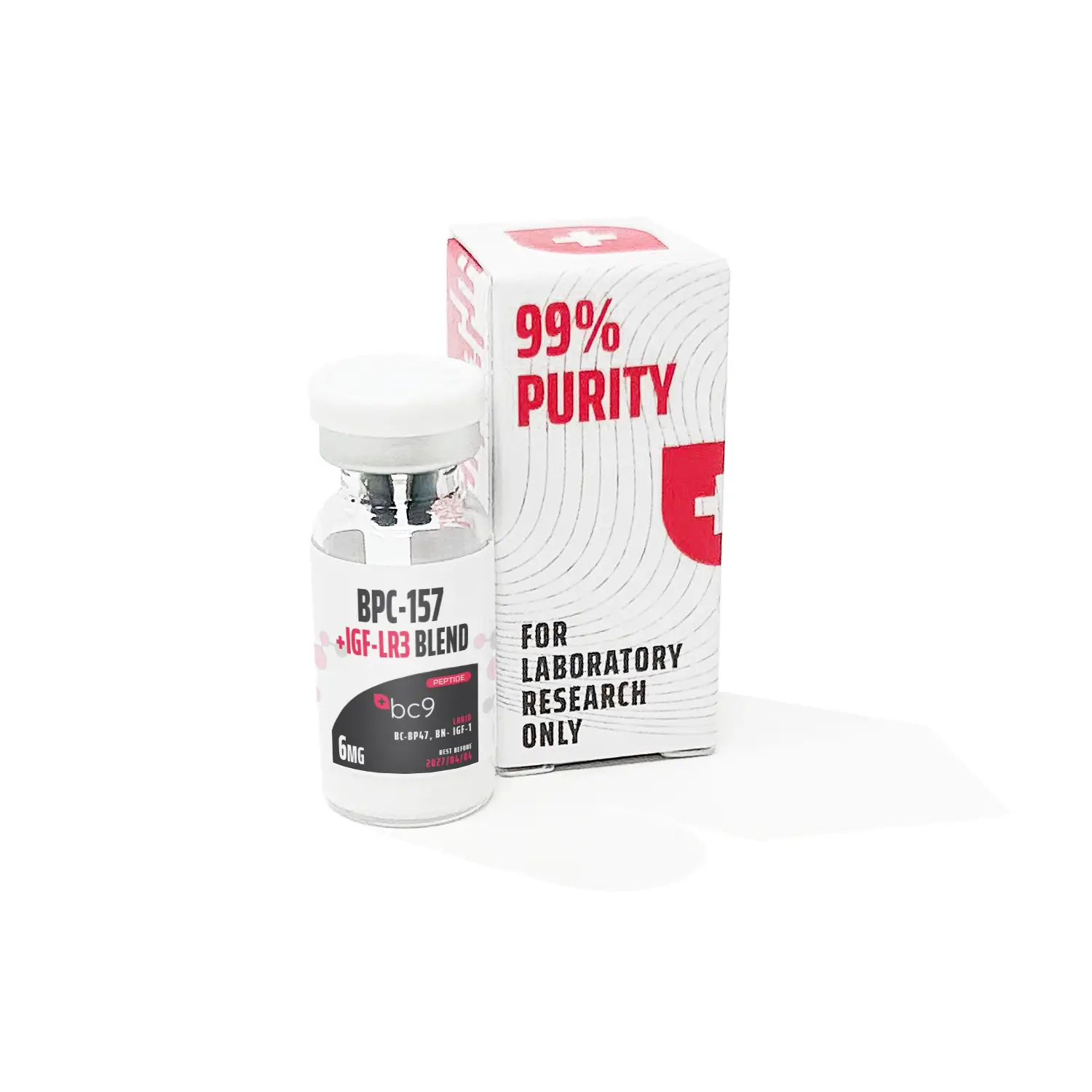
Description
IGF-LR3 Properties
| CAS Number | 946870-92-4 |
| Molar Mass | 9117.60 g·mol−1 |
| Chemical Formula | C400H625N111O115S9 |
| Synonyms | IBP1, IGF1, IGF-1, IGF1A, IGFI, IGF-I, IGF-IA, IGF-IB, MGF |
BPC-157 Properties
| CAS Number | 137525-51-0 |
| Molar Mass | 1419.5 g/mol |
| Chemical Formula | C62H98N16O22 |
| Synonyms | 137525-51-0, Bepecin, Bpc 15, pl-10 |
Product Overview of IGF-LR3 + BPC-157 Peptide
BC9’s IGF-LR3 + BPC-157 peptide blend is a research-grade formulation that brings together two of the most studied peptides in regenerative science:
- IGF-LR3: This chemical is a modified version of IGF-1. It is designed with an extended half-life, making it valuable for specific studies. These could be related to cell proliferation, muscle cell development, and protein synthesis.
- BPC-157: This is a peptide fragment obtained from gastric proteins. It is recognized in preclinical models for its potential role in angiogenesis, tissue repair, and cellular protection.
When combined, the investigational peptides offer researchers a dual pathway to study the following:
- Growth-promoting mechanisms
- Tissue-regenerative properties
Thus, BC9’s IGF-LR3 + BPC-157 peptide blend is a robust research tool for studies about cellular biology and peptide sciences.
Why Choose BC9 to Buy IGF-LR3 + BPC-157 Peptide Online
As you are looking to buy IGF-LR3 + BPC-157 blend, reliability and purity are critical. At BC9, we are committed to ensuring that every vial of IGF-LR3 + BPC-157 peptide for sale is manufactured under strict quality standards.
Here are the reasons why we are a top choice among researchers:
- Research-Grade Purity: Every BC9 compound is produced without adding unnecessary fillers or additives. This practice inevitably leads to precision and consistency in laboratory studies.
- Rigorous Quality Testing: Each batch of research products undergoes strict analysis. The goal is to ensure purity, reproducibility, and overall integrity before release.
- Complete Transparency: All BC9 research products include full documentation, detailing sourcing specifications and supporting data. This adds another layer of confidence to our research customers.
- Extensive Catalogue: Beyond IGF-LR3 + BPC-157, BC9 offers a broad selection of investigational compounds. These are clearly organized based on their potential effects.
- Trusted by Researchers: Our products are consistently rated highly by researchers who value dependability, quality, and uncompromising quality.
- Dedicated Support Team: BC9 staff are available 24/7. We are here to assist with orders, documentation, and technical inquiries.
- Flexible Payment Options: Multiple secure payment methods make it easy for you to order IGF-LR3 + BPC-157 online. This is one of the many ways we support your research moving forward.
- Free US Shipping: Your purchases of over $150 qualify for complimentary, discreet, and efficient delivery.
IGF-LR3 + BPC-157 Peptide’s Potential Research Applications
IMPORTANT: BC9 sells its IGF-LR3 + BPC-157 blend for research purposes only. This product is not approved for human consumption or medication. The potential effects mentioned below are based on laboratory settings. These are not proven to bring benefit to the human body. More studies are needed to verify the blend’s effects on humans.
Potential for Muscle, Tendon, and Bone Regeneration
IGF-LR3 has been frequently utilized in animal models to study muscle growth and recovery. One study involving mice with muscle injuries showed that administering IGF-LR3 may lead to enhanced muscle regeneration. [1]
On the other hand, BPC-157 demonstrated in rodents the ability to accelerate tendons and improve the alignment of collagen fibers. [2]
BC9’s IGF-LR3 + BPC-157 blend enables the exploration into how anabolic signaling works in concert with BPC-157’s tissue-healing properties.
Potential Research Tool for Gastrointestinal and Cytoprotective Studies
Preclinical studies with BPC-157 highlight its potential protective effects as observed in models of gastric and duodenal injury. This was also observed in those induced by NSAIDs. [3]
The blend could uncover how IGF-LR3’s proliferative activity intersects with BPC-157’s protective actions.
Potential for Supporting Neurological and Central Nervous System Applications
In rodent stroke models (e.g., ischemia-reperfusion injury via carotid artery clamping), BPC-157 administration has resulted in improved motor and cognitive functions. [4]
IGF1-LR3 has also been investigated for possible neuroprotective effects. This is due to the compound’s ability to cross the blood-brain barrier. [5]
Potential Research Compound for Cardiovascular and Liver Protection Studies
BPC-157 has demonstrated the following action in specific rodent models:
- Potentially reduce infarct size post-myocardial ischemia and protect vascular function [6]
- Counteract radiation-induced liver injury by reducing apoptosis and lowering liver enzymes (AST/ALT) [7]
On the flip side, IGF-1 is implicated in promoting vasodilation and reducing vasoconstriction, primarily through nitric oxide-mediated pathways. [8]
Thus, this specific blend may be valuable for modeling coordinated vascular, hepatic, and regenerative biology.
Potential Research Chemical for Molecular and Signaling Mechanism Investigations
IGF-LR3 is engineered for investigating growth factor signaling, receptor-mediated pathways, and metabolic regulation across tissues. [9]
Alternatively, BPC-157 interacts with multiple pathways. These include nitric oxide systems, MAPK signaling, and angiogenic growth factors (e.g, VEGF). [10]
Blending both peptides will enable rich exploration into intersecting signaling mechanisms. The information gathered may be valuable for understanding peptide-mediated modulation of growth, repair, and stress responses.
Frequently Asked Questions
What should I look for when I buy IGF-LR3 and BPC-157 peptide blend online?
When purchasing research peptides, focus on suppliers that provide high-purity compounds, transparent testing, and updated Certificates of Analysis. Also, buy a product that is explicitly labeled, “For laboratory research only.”
Why are IGF-LR3 and BPC-157 combined in a peptide blend?
IGF1-LR3 is studied for its growth-promoting and anabolic pathways. On the other hand, BPC-157 has been investigated for its healing and regenerative properties. When combined, researchers may investigate how these distinct mechanisms may work in synergy with biological systems.
What makes BC9 a reliable supplier for purchasing IGF-LR3 and BPC-157 peptide blend online?
BC9 is committed to purity, transparency, and consistency. Each of our products is batch-tested, giving researchers the confidence to receive accurate, high-quality peptides ideal for laboratory experiments.
How should IGF-LR3 + BPC-157 be stored?
For stability, peptides should generally be stored in a cool, dry environment. Reconstituted peptides are typically kept at -20°C to -80°C.
How do IGF-LR3 and BPC-157 complement each other in a blend?
IGF-LR3 is investigated for its ability to stimulate growth pathways. BPC-157 is explored for its repair and protective effects. Together, these compounds give researchers a comprehensive model to study cell growth and tissue recovery.
References:
- Sato, K., Li, Y., Foster, W., Fukushima, K., Badlani, N., Adachi, N., Usas, A., Fu, F. H., & Huard, J. (2003). Improvement of muscle healing through enhancement of muscle regeneration and prevention of fibrosis. Muscle & Nerve, 28(3), 365–372. https://doi.org/10.1002/mus.10436
- Staresinic, M., Sebecic, B., Patrlj, L., Jadrijevic, S., Suknaic, S., Perovic, D., Aralica, G., Zarkovic, N., Borovic, S., Srdjak, M., Hajdarevic, K., Kopljar, M., Batelja, L., Boban-Blagaic, A., Turcic, I., Anic, T., Seiwerth, S., & Sikiric, P. (2003). Gastric pentadecapeptide BPC 157 accelerates healing of transected rat Achilles tendon and in vitro stimulates tendocyte growth. Journal of Orthopaedic Research, 21(6), 976–983. https://doi.org/10.1016/s0736-0266(03)00110-4
- Spomenko Ilić, Domagoj Drmić, Franjić, S., Kolenc, D., Marijana Čorić, Luka Brčić, Kliček, R., Božo Radić, Sever, M., Viktor Djuzel, Marinko Filipović, Željko Djaković, Vasilije Stambolija, Alenka Boban Blagaić, Zoričić, I., Miroslav Gjurašin, Mirjana Stupnišek, Željko Romić, Kamelija Žarković, & Senka Džidić. (2011). Pentadecapeptide BPC 157 and its effects on a NSAID toxicity model: Diclofenac-induced gastrointestinal, liver, and encephalopathy lesions. Life Sciences, 88(11-12), 535–542. https://doi.org/10.1016/j.lfs.2011.01.015
- Predrag Sikiric, Slaven Gojkovic, Krezic, I., Ivan Maria Smoday, Luka Kalogjera, Zizek, H., Oroz, K., Vranes, H., Vukovic, V., Labidi, M., Sanja Strbe, Lidija Baketic Oreskovic, Sever, M., Marijan Tepes, Knezevic, M., Barisic, I., Vladimir Blagaic, Josipa Vlainic, Dobric, I., & Staresinic, M. (2023). Stable Gastric Pentadecapeptide BPC 157 May Recover Brain–Gut Axis and Gut–Brain Axis Function. 16(5), 676–676. https://doi.org/10.3390/ph16050676
- Ge, L., Liu, S., Rubin, L., Lazarovici, P., & Zheng, W. (2022). Research Progress on Neuroprotection of Insulin-like Growth Factor-1 towards Glutamate-Induced Neurotoxicity. Cells, 11(4), 666–666. https://doi.org/10.3390/cells11040666
- Sikiric, P., Udovicic, M., Barisic, I., Balenovic, D., Zivanovic Posilovic, G., Strinic, D., Uzun, S., Sikiric, S., Krezic, I., Zizek, H., Yago, H., Gojkovic, S., Smoday, I. M., Kalogjera, L., Vranes, H., Sola, M., Strbe, S., Koprivanac, A., Premuzic Mestrovic, I., & Mestrovic, T. (2022). Stable Gastric Pentadecapeptide BPC 157 as Useful Cytoprotective Peptide Therapy in the Heart Disturbances, Myocardial Infarction, Heart Failure, Pulmonary Hypertension, Arrhythmias, and Thrombosis Presentation. Biomedicines, 10(11), 2696. https://doi.org/10.3390/biomedicines10112696
- Huang, B.-S., Huang, S.-C., Chen, F.-H., Chang, Y., Mei, H.-F., Huang, H.-Y., Chen, W.-Y., & Jong-Hwei Su Pang. (2022). Pentadecapeptide BPC 157 efficiently reduces radiation-induced liver injury and lipid accumulation through Kruppel-like factor 4 upregulation both in vivo and in vitro. Life Sciences, 310, 121072–121072. https://doi.org/10.1016/j.lfs.2022.121072
- Macvanin, M., Gluvic, Z., Radovanovic, J., Essack, M., Gao, X., & Isenovic, E. R. (2023). New insights on the cardiovascular effects of IGF-1. Frontiers in Endocrinology, 14, 1142644. https://doi.org/10.3389/fendo.2023.1142644
- Bailes, J., & Soloviev, M. (2021). Insulin-Like Growth Factor-1 (IGF-1) and Its Monitoring in Medical Diagnostic and in Sports. Biomolecules, 11(2), 217. https://doi.org/10.3390/biom11020217
- Hsieh, M.-J., Liu, H.-T., Wang, C.-N., Huang, H.-Y., Lin, Y., Ko, Y.-S., Wang, J.-S., Chang, V. H.-S., & Pang, J.-H. S. (2016). Therapeutic potential of pro-angiogenic BPC157 is associated with VEGFR2 activation and up-regulation. Journal of Molecular Medicine, 95(3), 323–333. https://doi.org/10.1007/s00109-016-1488-y


Reviews
There are no reviews yet