
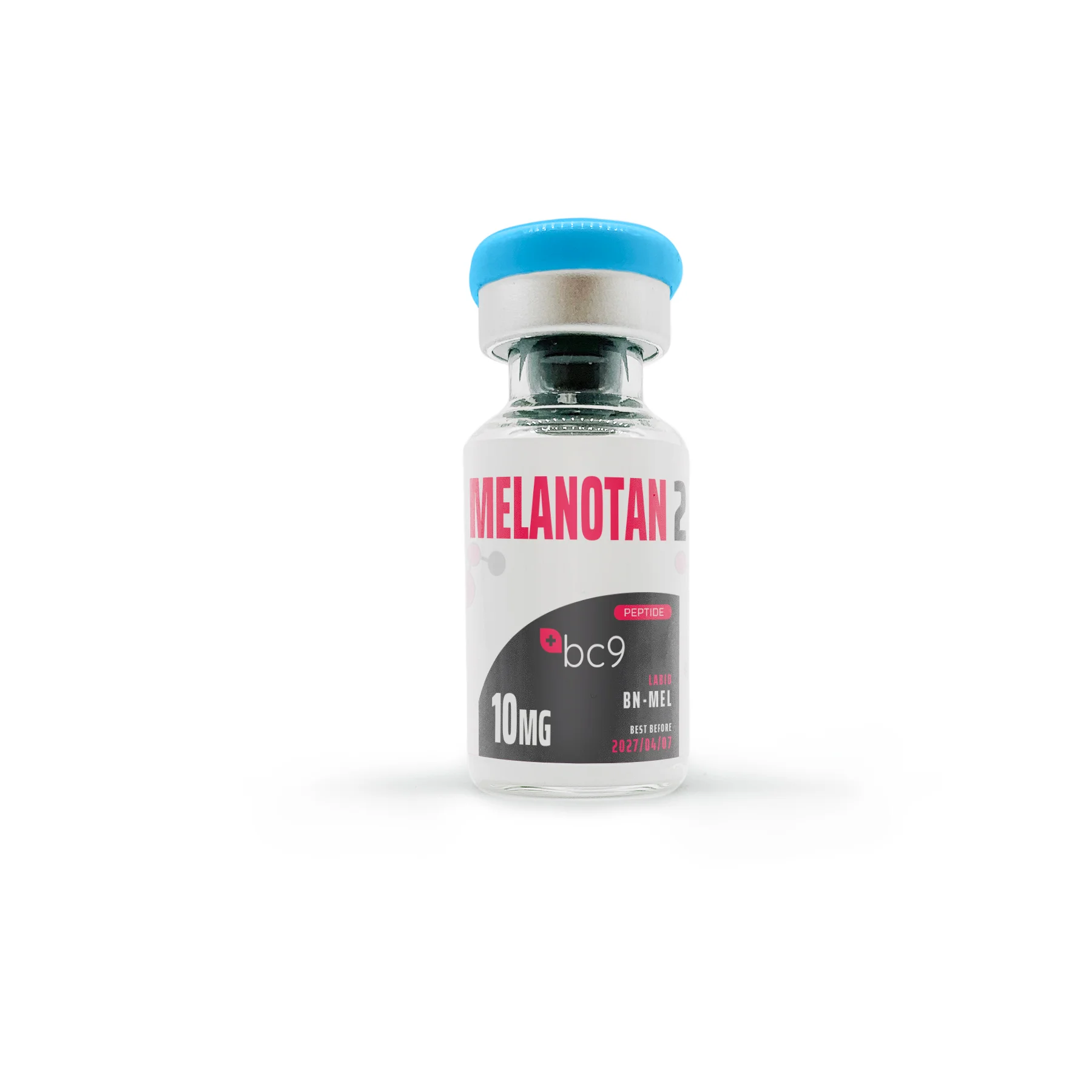
Description
Properties
| CAS Number | 121062-08-6 |
| Molar Mass | 1024.2 g/mol |
| Chemical Formula | C50H69N15O9 |
| Synonyms | Melanotan-II, UPF5CJ93X7, DTXSID90153135 |
Product Overview of Melanotan II
Melanotan-2 (MT-2) is a synthetic analogue of the naturally occurring hormone α-melanocyte-stimulating hormone (α-MSH). It has been investigated in laboratory settings for its ability to interact with melanocortin receptors. These play a specific role in the following:
- Skin pigmentation
- Energy homeostasis
- Physiological processes
Melanotan-2 was originally developed in experimental settings to study melanocortin receptor function and its downstream effects. It has since been explored in laboratory research for potential roles in pigmentation, appetite regulation, metabolic studies, and neuroscience.
IMPORTANT: Melanotan-2 is not approved for medical or cosmetic use by regulatory authorities such as the FDA, EMA, or MHRA. BC9 supplies its melanotan-2 product strictly for research purposes only.
Why Choose BC9 to Buy Melanotan-2 Online
At BC9, we recognize the importance of consistency and reliability when it comes to research peptides. Thus, every batch of Melanotan-2 we supply undergoes stringent quality checks. This practice ensures purity, stability, and reproducibility in laboratory settings. Our goal is to support researchers with dependable compounds that deliver confidence in experimental outcomes.
Here’s why researchers continue to choose BC9:
- Comprehensive peptide catalogue covering a wide range of research needs
- Verified Certificates of Analysis (COAs) provided for transparency and traceability
- Dedicated customer support, ready to provide necessary support with product details and technical inquiries
- Secure, discreet, and professional packaging to ensure safe delivery of your order
- Free shipping for US customers, provided your orders are above $150
Potential Research Applications of Melanotan-2
Neuroregeneration and Neuroprotection
Some animal studies suggest that Melanotan-2 may promote nerve repair and protect nerve tissue following an injury.
For example, one study involved a rat sciatic nerve model. MT-II was observed to enhance the model’s recovery of sensory function. It even showed possible protective effects against toxins. [1]
Effects on Appetite, Feeding Behavior, and Weight Regulation
MT-II was also studied for its effect on food consumption and motivation. These were observed in studies where Melanotan-2 was administered to specific brain regions of the mice. The findings suggest that the research peptide may reduce both the amount of food consumed and the motivation to obtain food. [2]
Influence on Insulin Sensitivity and Glucose Metabolism
In some studies, MT-II was administered centrally among mouse models. Here, researchers observed the improvement of insulin-mediated glucose disposal. The action indicated enhanced peripheral insulin sensitivity. [3]
Thermogenesis and Energy Expenditure
MT-II has also been studied for its effects on thermogenesis. One study investigated mice that lack the neuropeptide PACAP. MT-II administration was observed to partially rescue the impaired thermogenic response to cold exposure. [4]
Modulation of Oxytocin Neuronal Activity and Brain Signaling
MT-II was also able to demonstrate its potential ability to influence brain activity. This occurred particularly in regions and cell populations involved in neuroendocrine regulation.
For instance, systemic administration of MT-II in rat models resulted in increased activity in magnocellular neurons. The peptide also appeared to promote an increase in the firing rate of oxytocin neurons. [5]
Frequently Asked Questions
Is Melanotan-2 approved for human use?
No. Melanotan-2 is not approved for human or veterinary use. It falls under the category of research chemicals, suggesting it should only be purchased for research purposes.
How should I purchase Melanotan-2 online?
When purchasing Melanotan-2 online, it is vital to source from a supplier that:
- Clearly labels products “For Laboratory Research Only”
- Provides “Certificates of Analysis” (COAs) for quality verification
- Demonstrates transparency in storage, handling, and delivery methods
- Offers 24/7 customer support to address client product inquiries
BC9 checks all these boxes because our commitment is to help researchers receive high-quality, research-grade compounds.
What is Melanotan-2 being studied for?
In preclinical and laboratory research, Melanotan-2 has been studied for its potential in:
- Pigmentation pathways
- Metabolic regulation
- Neuroscience
These applications remain experimental. More studies are required to understand Melanotan-2’s potential mechanisms and safety profiles.
What makes BC9 a reliable online supplier of Melanotan-2?
Several reasons explain why BC9 is trusted by researchers:
- Rigorous quality control
- Consistent batch testing
- Availability of COAs for transparency
- Secure and discreet packaging
- Responsive support team
These practices ensure BC9 clients that they can purchase Melanotan-2 with confidence since the product is meticulously manufactured. Plus, our knowledgeable and responsive customer support team is here to address your concerns.
How does Melanotan-2 work based on research settings?
In laboratory studies, Melanotan-2 has been shown to interact with melanocortin receptors. These are believed to be involved in multiple biological processes. Examples of these are pigmentation, energy metabolism, and neuroendocrine signaling.
Theoretically, when Melanotan-2 activates the mentioned pathways, it may serve as a useful research tool for studying receptor function.
References
- Ter Laak, M. P., Brakkee, J. H., Adan, R. A. H., Hamers, F. P. T., & Gispen, W. H. (2003). The potent melanocortin receptor agonist melanotan-II promotes peripheral nerve regeneration and has neuroprotective properties in the rat. European Journal of Pharmacology, 462(1-3), 179–183. https://doi.org/10.1016/s0014-2999(02)02945-x
- Eliason, N. L., Martin, L., Low, M. J., & Sharpe, A. L. (2022). Melanocortin receptor agonist melanotan-II microinjected in the nucleus accumbens decreases appetitive and consumptive responding for food. Neuropeptides, 96, 102289–102289. https://doi.org/10.1016/j.npep.2022.102289
- Heijboer, A. C., van den Hoek, A. M., Pijl, H., Voshol, P. J., Havekes, L. M., Romijn, J. A., & Corssmit, E. P. M. (2005). Intracerebroventricular administration of melanotan II increases insulin sensitivity of glucose disposal in mice. Diabetologia, 48(8), 1621–1626. https://doi.org/10.1007/s00125-005-1838-8
- McMillan, T. R., Forster, M. A. M., Short, L. I., Rudecki, A. P., Cline, D. L., & Gray, S. L. (2021). Melanotan II, a melanocortin agonist, partially rescues the impaired thermogenic capacity of pituitary adenylate cyclase-activating polypeptide-deficient mice. Experimental Physiology, 106(2), 427–437. https://doi.org/10.1113/EP088838
- Paiva, L., Sabatier, N., Leng, G., & Ludwig, M. (2017). Effect of Melanotan-II on Brain Fos Immunoreactivity and Oxytocin Neuronal Activity and Secretion in Rats. Journal of Neuroendocrinology, 29(2), 10.1111/jne 12454. https://doi.org/10.1111/jne.12454


Matthew Parker –
Excellent service and premium quality. Will definitely order again.